9 TTS Models, One Week: Why Picking a Single AI Voice Engine Is Already the Wrong Move
The Market Just Got Nine Times More Complicated
This week, OpenRouter updated its May 2026 TTS model rankings with real usage data, and the result is striking. Nine distinct text-to-speech models now compete for top position, from Google's Gemini 3.1 Flash TTS Preview to OpenAI's GPT-4o Mini TTS, xAI's Grok Voice TTS 1.0, Mistral's Voxtral Mini TTS, and several strong open-weight challengers including Kokoro 82M, Orpheus 3B, and Zonos from Zyphra. That list does not include the dozens of models available through direct provider APIs or self-hosted deployments.
Google's Gemini 3.1 Flash TTS Preview sits at the top with 70+ language support, 200+ inline audio tags, and a new director-level workflow for defining per-character voice profiles. ElevenLabs, meanwhile, just launched Music v2, pushing deeper into generative audio. The message from the market is clear: every major AI lab now has a voice stack, and they are all moving fast.
For developers and production teams shipping voice-powered products, this should raise a direct question: which model do you trust with your audio in production, and what happens when it fails?
What a Nine-Model Market Actually Reveals
The proliferation of TTS models is not a problem of abundance. It is a problem of accountability. Each model on that OpenRouter list carries a different set of tradeoffs: language coverage, pricing per million tokens, context window size, latency profile, emotional control, output format, and watermarking behavior. Google's Gemini Flash TTS costs $20 per million output tokens and outputs PCM at 24 kHz. Kokoro 82M costs $0.62 per million input tokens and covers 8 languages. xAI's Grok Voice TTS supports 20+ languages but costs $15 per million input tokens.
No single model wins across every dimension. A model that delivers natural prosody in English at low latency may mispronounce proper nouns in Japanese. A model optimized for multilingual coverage may fail on technical terminology in customer service workflows. A model that works perfectly in testing may return degraded output under load, or produce audio artifacts on certain phoneme combinations that only surface at scale.
When a single model fails, production stops. Audio files ship broken. Customers hear glitches. Localized content goes out with wrong pronunciations. And the team running the pipeline often has no automated way to catch it before it hits the end user.
The Industry Gets the Selection Problem Wrong
The standard approach to AI voice production treats model selection as a one-time architectural decision. A team evaluates a handful of models, picks the one that performs best in a sample test, integrates it, and moves on. That decision then sits in place for months, even as the underlying model updates, pricing shifts, and better alternatives launch.
This is the same mistake the industry made with large language models before orchestration layers became standard practice. Nobody runs a single LLM across every task in a production AI system anymore. Teams route prompts to different models based on cost, speed, and capability. They build fallback chains. They validate outputs before shipping them downstream.
Voice production needs the same architecture, and it does not have it yet. Most teams run a single TTS provider, wrap it in a thin API call, and hope the output is good enough. There is no validation layer checking pronunciation accuracy. No retry logic when a model returns an artifact. No model-switching when latency spikes or a provider goes down. No systematic quality gate between the TTS call and the final audio file.
The result is audio that ships with errors nobody caught, because nobody built the infrastructure to catch them.
Orchestration Is the Missing Layer
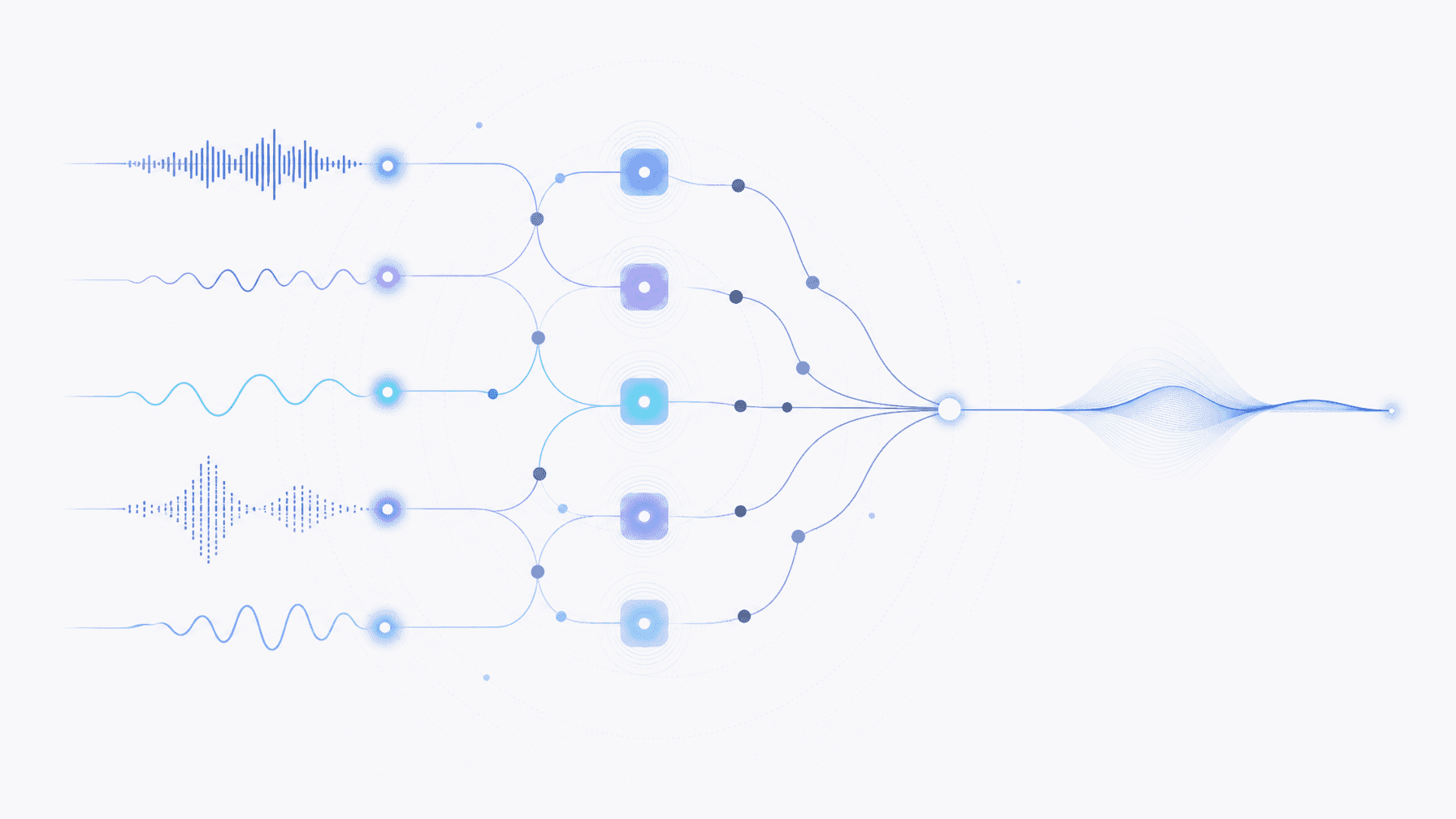
The nine-model TTS landscape on OpenRouter is not a reason to pick the top-ranked model and commit. It is an argument for building the layer that sits above all of them.
A proper voice production pipeline does not route every request to a single model and accept whatever it returns. It plans the job, selects the right model for the specific content type and language, runs the generation, validates the output against a pronunciation and quality baseline, retries on failure, and switches to an alternative model when the primary provider degrades. It treats audio production the same way a senior engineer treats any mission-critical pipeline: with checkpoints, fallbacks, and observable outputs.
That is the architectural pattern Onepin implements. It sits above 100+ TTS models worldwide, runs the full production cycle from planning through validation, and ships publish-ready audio without requiring the downstream team to manage model selection, retry logic, or quality control manually. When a model produces a mispronunciation or an artifact, Onepin catches it and reruns before the file leaves the pipeline. When a provider has a latency issue, Onepin routes to an alternative. The team receives finished audio, not raw TTS output that still needs human review.
As the TTS market adds more models every month, the value of that orchestration layer compounds. Each new model is another option to route to when the situation calls for it, not another integration to manage, not another failure mode to monitor, not another reason to audit your audio output manually.
What This Week Tells You
Nine competitive TTS models in a single rankings update is a signal. The voice AI market is in active expansion. Model capabilities are improving fast. Pricing is compressing. And the operational complexity of running voice in production is rising proportionally.
Teams that treat voice production as a solved problem, one model and one API key, are already behind the curve. The question is not which TTS model to use. The question is how to build a production system that uses the right model for every job, validates every output, and does not let a single model failure reach the end user.
That infrastructure exists. Onepin builds it for you.
Frequently asked questions
- How many TTS models were in OpenRouter's May 2026 rankings?
- OpenRouter's May 2026 update listed nine distinct text-to-speech models competing for the top spot, including Google's Gemini 3.1 Flash TTS Preview, OpenAI's GPT-4o Mini TTS, xAI's Grok Voice TTS 1.0, Mistral's Voxtral Mini TTS, and open-weight options such as Kokoro 82M, Orpheus 3B, and Zonos from Zyphra. That count excludes the many models available through direct provider APIs or self-hosted deployments.
- Why is picking a single TTS model the wrong approach?
- No single model wins across every dimension of language coverage, pricing, latency, emotional control, and output format. A model with natural English prosody may mispronounce proper nouns in Japanese, and one optimized for multilingual coverage may fail on technical terms. When the one model you chose fails, production stops and broken audio ships.
- What does TTS orchestration add on top of a model?
- An orchestration layer plans the job, selects the right model for the content type and language, validates output against a pronunciation and quality baseline, retries on failure, and switches to an alternative model when the primary provider degrades. It treats audio production like any mission-critical pipeline, with checkpoints, fallbacks, and observable outputs.
- How does Onepin handle the growing number of TTS models?
- Onepin sits above 100+ TTS models worldwide and runs the full production cycle from planning through validation, shipping publish-ready audio without the downstream team managing model selection, retry logic, or quality control manually. When a model produces a mispronunciation or artifact, Onepin catches it and reruns before the file leaves the pipeline, and it routes to an alternative when a provider has latency issues.