Agora and Gradium Call 'No Orchestration Layer' a Feature. Here's What That Actually Removes.
Agora and Gradium Call 'No Orchestration Layer' a Feature. Here's What That Actually Removes.
TLDR
- Agora and Gradium announced a TTS partnership on July 8, 2026, integrating Gradium's text-to-speech directly into Agora's Conversational AI Engine.
- Their explicit selling point: "no additional orchestration layer, no extra latency hops."
- Removing the orchestration layer removes quality validation, model version locking, fallback routing, format compliance, and audit trails.
- Low latency is one production metric. It is not the same as production readiness.
Agora and Gradium announced a strategic partnership on July 8, 2026. Gradium's text-to-speech technology, built from the research of Kyutai (the lab behind Moshi and Hibiki), will integrate directly into Agora's Conversational AI Engine. Developers building on the platform will be able to enable Gradium's TTS with a single configuration flag.
The value proposition, in their own words: "no separate accounts, no additional orchestration layer, no extra latency hops."
Gradium delivers compelling specs. The press release cites a median time-to-first-audio of approximately 155 milliseconds under concurrent load, which is genuinely fast. Voice cloning from a 10-second reference sample. Five deployment modes from shared cloud to on-premises. Coverage for English, French, German, Spanish, and Portuguese.
The integration is real. The latency numbers are real. The missing piece is what "no additional orchestration layer" actually removes from a production pipeline.
What does "no orchestration layer" mean for production voice AI?
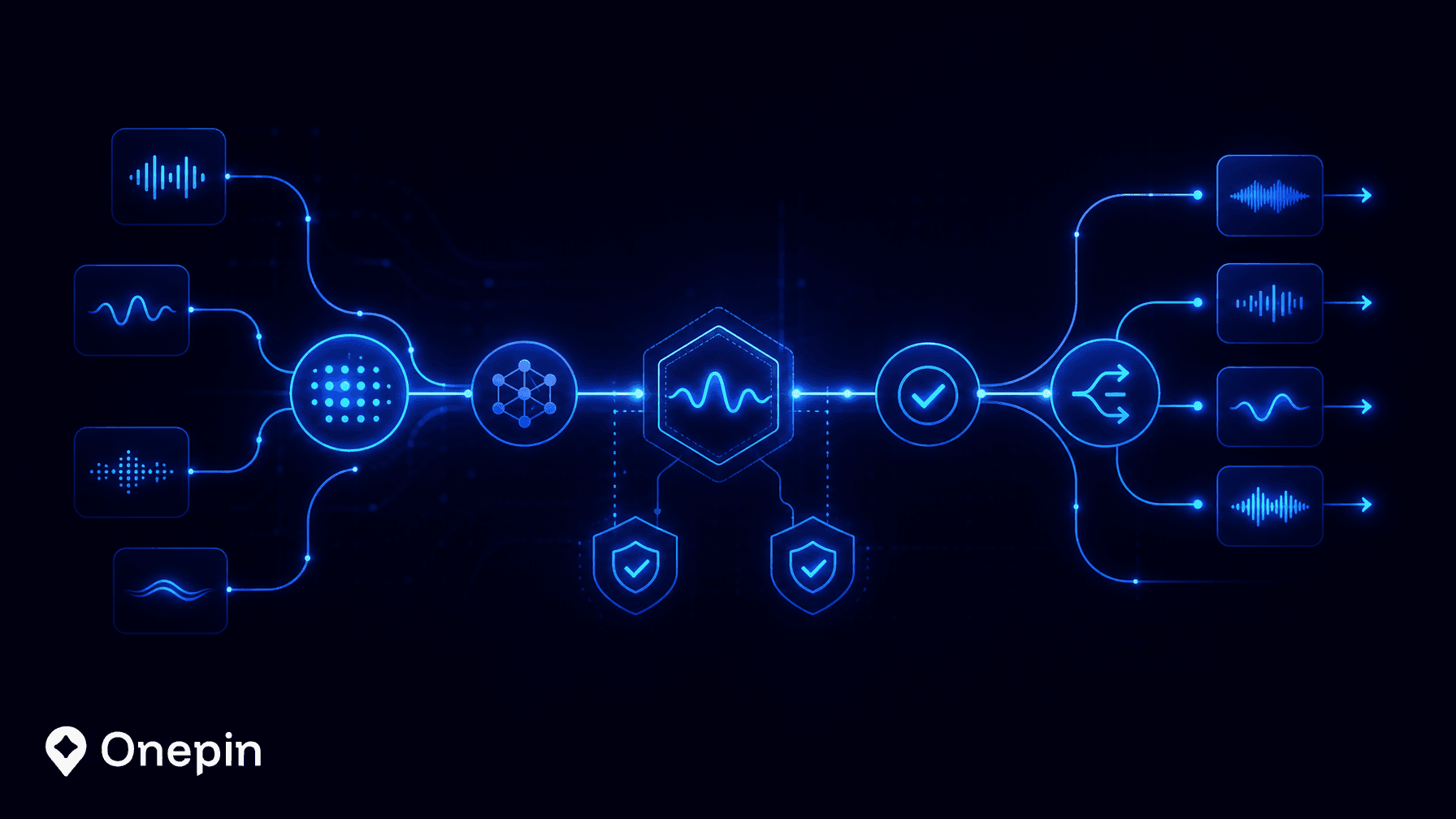
The orchestration layer in a voice AI stack is the component that sits above the TTS model and handles everything the model does not. It validates output quality before audio ships. It locks model versions so that your validated voice behavior does not silently change when the provider updates their model. It routes failed or substandard outputs to a fallback provider. It records a per-output quality score and model version for the audit trail.
When Agora and Gradium market "no additional orchestration layer" as a feature, they mean their integration does not require separate account setup or added network hops. That is a legitimate simplification. What it also means, by definition, is that none of the above production-layer capabilities come with the integration.
Developers get Gradium's TTS delivered over Agora's global network. They do not get a validation gate, a version lock, a fallback path, or a quality record. Those responsibilities sit with the team building the application.
Is low-latency TTS the same as production-ready TTS?
No. These are different measurements of different things.
Latency measures the time from text input to the first byte of audio output. Gradium's 155ms P50 figure is a transport and generation metric. It answers: how fast does audio start arriving?
Production readiness measures whether audio that arrives fast is also correct, consistent, compliant, and auditable. It answers: is the audio safe to ship?
A voice agent that responds in 155 milliseconds and mispronounces your brand name on 2% of calls generates roughly 200 bad outputs per 10,000 interactions, with no mechanism to catch them before they reach users. A voice agent that responds in 220 milliseconds, validates pronunciation accuracy against a reference, and routes substandard clips to ElevenLabs or Cartesia ships zero unvalidated outputs.
The latency difference is 65 milliseconds. Users rarely notice 65 milliseconds. They do notice a mispronounced product name. They do notice a voice that sounds different from the one they heard last week because the provider updated their model.
What production failures does a single-vendor integration create?
Building on a single TTS provider with no orchestration layer creates four compounding risks.
Pronunciation drift with no backstop. Gradium supports five languages. Production teams serving users in those five languages still need pronunciation validation for brand names, product terms, proper nouns, and numeric sequences. No TTS model ships with a pronunciation QA gate. That gate has to exist in the layer above the model, the layer this integration removes.
Silent model version changes. When Gradium ships a model update (improved naturalness, adjusted prosody, retrained voice profiles), integrated applications receive those changes immediately. Without a version lock layer, teams cannot control when their validated voice behavior changes or compare current outputs against their approved baseline. Version drift is how quality regressions arrive as user complaints rather than as engineering alerts.
Single point of failure with no fallback. Agora's network spans 200+ points of presence across six continents. That handles transport redundancy. It does not handle the case where Gradium's TTS service degrades, returns substandard audio quality, or goes offline entirely. A single-vendor integration with no fallback routing means your voice layer status is identical to Gradium's service status.
No audit trail for compliance or debugging. When a quality issue surfaces (wrong pronunciation, inconsistent voice, unexpected output format), a production audit trail answers: which model version ran, what quality score did the output receive, and which delivery path did it take? Without an orchestration layer recording this data per output, debugging a voice quality complaint means reconstructing context from logs that may not exist.
How does Onepin address what the Agora-Gradium integration skips?
Onepin is a voice workflow platform that orchestrates, validates, and ships production-ready audio across 100+ TTS models. It is the layer that sits above any TTS integration, including a Gradium integration when Gradium is the right model for a given use case.
Within a Onepin workflow, Gradium's speed and Kyutai's research translate into low-latency first-pass generation. Onepin then validates the output against a pronunciation reference profile, scores it for acoustic quality, and either delivers it or routes to Deepgram or another provider in the workflow, depending on the quality threshold you define and the language requirements of the request.
Model version changes become observable events rather than invisible production shifts. Format compliance for IVR telephony, specific codec requirements, or loudness normalization targets applies consistently regardless of which model generated the audio. Every output leaves with a quality record and model version stamp.
Agora and Gradium built a fast integration for developers who need TTS in their conversational AI platform. For teams shipping voice AI to real users at scale, fast is necessary but not sufficient.
The orchestration layer is not overhead. It is what separates generation from production.