AI Agents for Local Businesses: Chatbots, Voice, and What Actually Works in 2026
TLDR
AI agents for local businesses handle customer questions, book appointments, capture leads, and manage phone calls around the clock. The global chatbot market hit $11.8 billion in 2026 and is growing at 19.6% annually (Grand View Research). About 18% of all U.S. firms have adopted AI as of year-end 2025 (Federal Reserve), and small businesses are the fastest-growing segment. Two categories matter most for local businesses: AI chatbots for text-based channels and AI voice agents for phone calls.
What Are AI Agents for Local Businesses?
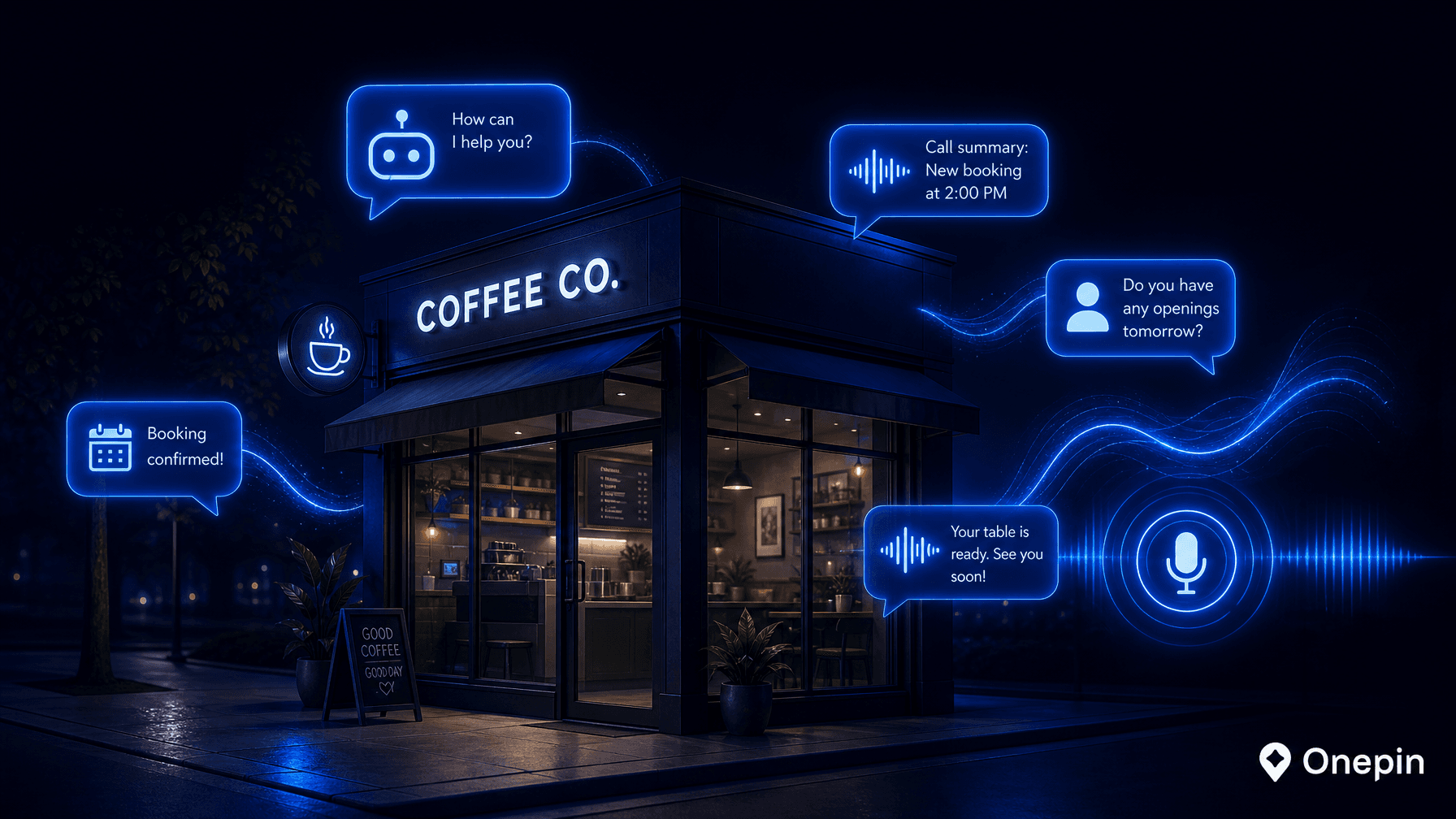
AI agents for local businesses are software tools that automate customer interactions across text and voice channels. They answer frequently asked questions, schedule appointments, qualify leads, check inventory, and hand off complex issues to a human, all without requiring a customer to wait on hold or send an email during business hours.
The category splits into two main types: AI chatbots that handle text-based conversations on websites, WhatsApp, Instagram, and SMS, and AI voice agents that handle phone calls with synthesized speech.
Both types run 24/7. For a dentist's office, salon, restaurant, or real estate agency, that means every after-hours inquiry gets a response instead of going to voicemail or an unread contact form.
Why Do Local Businesses Need AI Agents in 2026?
Customer expectations have shifted. Gartner predicts agentic AI will autonomously resolve 80% of common customer service issues without human intervention by 2029. Local businesses that rely on a single receptionist or an owner checking voicemail between jobs are already losing leads to competitors with always-on AI.
The economics are straightforward. A missed call from a potential customer costs a plumber or contractor anywhere from $200 to $2,000 in lost revenue. An AI agent that answers that call or chat message at 9pm on a Sunday pays for itself with a single converted lead.
Small and medium enterprises also record the highest growth rate in chatbot adoption, according to Mordor Intelligence. The tools are cheaper, easier to deploy, and more capable than they were even 12 months ago.
How Do AI Chatbots Work for Local Businesses?
AI chatbots for local businesses are trained on the business's own content: menus, price lists, service descriptions, FAQs, and appointment availability. When a customer asks a question, the chatbot retrieves the answer from that knowledge base. When it does not know the answer, it says so and routes the conversation to a human.
A strong example of this approach is Ovellan, an AI chatbot platform built specifically for local businesses and webshops. Ovellan trains on a business's own content and goes live in about 15 minutes with a single line of code. It handles product questions with live stock checks for e-commerce stores, books appointments for salons and clinics, answers menu and allergen questions for restaurants in 40+ languages, and qualifies leads for real estate agents. It works across website chat, WhatsApp, Instagram, Messenger, Telegram, SMS, and Slack, all routed into a single shared inbox for the team.
What makes this category practical for small teams is the no-code setup. A dentist does not need a developer to get patient intake questions answered automatically. A salon owner does not need to build an integration to let clients rebook online.
For e-commerce specifically, Shopify and WooCommerce integrations let chatbots check real-time inventory and send shoppers directly to checkout, turning a support interaction into a sale.
How Do AI Voice Agents Work for Local Businesses?
AI voice agents handle the phone channel. When a customer calls, the voice agent picks up, understands the request using speech-to-text, generates a response, and speaks it back using text-to-speech. The entire interaction happens in real time.
For local businesses that rely on phone calls (contractors, medical offices, legal intake, restaurants taking reservations), voice agents solve the staffing gap without hiring additional receptionists.
The production challenge with voice agents is different from chatbots. A chatbot displays text on screen, so a small formatting error is visible and harmless. A voice agent speaks audio with no visual fallback. If it mispronounces a street address, medication name, or appointment time, the caller has no way to verify what they heard.
Onepin is a voice workflow platform that orchestrates, validates, and ships production-ready audio across 100+ TTS models. It sits above the text-to-speech engine and handles the production layer: routing each request to the best model, validating pronunciation, locking model versions so the voice does not change overnight, scoring every output against a quality baseline, and regenerating only the clips that fail. For local businesses scaling voice interactions across multiple locations or languages, this production layer is the difference between a voice agent that works in a demo and one that works at 10,000 calls per month.
What Should You Look for When Choosing an AI Agent?
Five criteria separate tools that work from tools that create more problems than they solve:
-
Setup time. If it takes more than an hour to go live, the tool is built for enterprises, not local businesses. Look for platforms that train on your existing website content and require minimal configuration.
-
Channel coverage. Your customers reach you through different channels: website, WhatsApp, phone, Instagram DMs, email. The agent should meet them where they already are, not force them onto a single channel.
-
Handoff to humans. No AI agent handles every situation. The tool must route complex or sensitive conversations to your team with the full conversation history attached.
-
Data privacy and hosting. For businesses in the EU, GDPR compliance and EU-hosted data storage are requirements, not features. Platforms like Ovellan host data in Germany and never move it outside the EU. For voice agents, check whether audio recordings are stored, where, and for how long.
-
Pricing transparency. Per-workspace pricing (where your whole team is included) is more predictable than per-seat or per-conversation models that scale unpredictably.
What Is the Difference Between a Chatbot and a Voice Agent?
A chatbot handles text. A voice agent handles speech. They solve different problems for the same business.
A restaurant might use a chatbot on its website to answer menu questions, check allergen information, and take reservation requests in any language. That same restaurant might use a voice agent to answer phone calls, confirm reservations, and handle takeout orders during the dinner rush when the staff is busy.
The two categories also have different failure modes. Chatbot failures are visible: a wrong answer shows up on screen and the customer can ask again or contact a human. Voice agent failures are invisible: a mispronounced address or incorrect price is heard once and acted on. Production-grade voice agents require a validation layer that scores every output before it reaches the caller.
For most local businesses starting out, a chatbot covers the highest-value use case (24/7 availability on the channels customers already use). Voice agents become essential as call volume grows or when the business operates in an industry where phone calls are the primary customer channel.
How Much Do AI Agents Cost for Local Businesses?
Chatbot pricing for local businesses typically follows a monthly subscription model. Ovellan offers plans starting at €29/month for Starter (no credit card required for the free trial), €79 for Pro, and €149 for Business, with Enterprise pricing available on request. All plans are per-workspace, so every team member is included.
Voice agent pricing varies more. Most providers charge per minute of call time, with rates ranging from $0.05 to $0.15 per minute depending on the model and provider. The total cost depends on call volume, call duration, and whether multilingual support is needed.
The ROI calculation for local businesses is simple: compare the monthly cost of the AI agent against the value of leads and appointments you currently lose to missed calls, slow response times, or limited business hours.
Conclusion
AI agents for local businesses are no longer experimental. The tools are affordable, deploy in minutes, and cover the two channels that matter most: text and voice. Chatbot platforms like Ovellan handle the text side with no-code setup, multilingual support, and integrations with the tools local businesses already use. Voice workflow platforms like Onepin handle the audio side with production-grade validation and multi-model orchestration. Together, they give a two-person salon or a 50-location franchise the same always-on customer experience that enterprise companies have had for years.
Frequently asked questions
- What is an AI agent for local businesses?
- An AI agent for local businesses is software that handles customer interactions automatically, through chat on a website, messaging apps, or phone calls. It answers questions, books appointments, captures leads, and routes complex requests to a human, running 24/7 without additional staff.
- Can a small business set up an AI chatbot without a developer?
- Yes. Most modern AI chatbot platforms designed for local businesses require no coding. You upload your business content, customize the look, and embed a single line of code on your website. Setup typically takes 15 to 30 minutes.
- What is the difference between an AI chatbot and an AI voice agent?
- An AI chatbot handles text-based interactions on websites, WhatsApp, Instagram, and other messaging channels. An AI voice agent handles phone calls, generating spoken audio in real time. Many local businesses use both to cover every customer touchpoint.
- How much does an AI agent cost for a small business?
- Pricing varies by provider and feature set. AI chatbot platforms for local businesses typically start between 29 and 79 euros or dollars per month. AI voice agent costs depend on call volume, usually charged per minute or per conversation.
- Is my customer data safe with an AI agent?
- Reputable AI agent providers offer encryption, GDPR compliance, and regional data hosting. Check whether the provider stores data in your region, supports data export and deletion, and processes payments through a trusted gateway like Stripe.