AI Dubbing and Video Localization Guide (2026): Architecting End-to-End Multilingual Workflows
TLDR
Traditional dubbing takes weeks and costs thousands of dollars per hour of footage. Modern AI dubbing automates speech-to-text, neural translation, text-to-speech synthesis, and lip synchronization to deliver studio-quality multilingual video in minutes. Building a resilient pipeline requires multi-model orchestration, strict pronunciation checks, and voice preservation across languages.
AI Dubbing and Video Localization Guide (2026)
Video production teams and content platforms face unprecedented demand for global reach. Manual dubbing workflows, which rely on booking voice talent, recording studios, and sound engineers, cannot scale to meet rapid content cycles across dozens of target markets.
AI dubbing solves this bottleneck by combining generative speech models, machine translation, and video processing into automated localization pipelines. This guide breaks down the core architecture, key software capabilities, and quality validation strategies required to deploy enterprise-grade AI video dubbing.
What is AI Dubbing?
AI dubbing is the automated process of translating and re-voicing video content into secondary languages while preserving speaker emotion, pacing, and tone. Unlike traditional subtitling or basic voiceover generation, complete AI dubbing synchronizes spoken audio with video visual cues and actor lip movements.
[Source Video] ➔ [Speech-to-Text] ➔ [Machine Translation] ➔ [Neural TTS Synthesis] ➔ [Lip Sync & Alignment] ➔ [Multilingual Output]
Key Differences: Voiceover vs. AI Dubbing
| Feature | Standard AI Voiceover | Advanced AI Dubbing |
|---|---|---|
| Input | Plain raw text scripts | Source video or multi-track audio |
| Timing Alignment | Fixed speed playback | Dynamic time-stretching & video frame matching |
| Speaker Diarization | Single voice assignment | Multi-speaker identification & voice cloning |
| Visual Sync | None | Neural lip synchronization & face re-rendering |
| Emotion Transfer | Static tone settings | Contextual emotional transfer from original audio |
Core Components of an AI Dubbing Pipeline
Building a production-ready AI dubbing workflow requires integrating five discrete technical stages:
1. Speaker Diarization & Speech-to-Text (STT)
The pipeline isolates background music, sound effects, and dialogue tracks using stem separation. Speech recognition models then transcribe spoken audio into timestamped text, identifying separate speakers across conversation turns.
2. Context-Aware Translation
Raw machine translation often fails on idiomatic expressions, slang, and cultural references. Enterprise localization stacks utilize translation models tuned for dialogue length constraints, ensuring target phrase durations match source audio timestamps.
3. Voice Cloning & Cross-Lingual TTS
To preserve brand identity or actor voice recognition, voice cloning engines analyze 30 to 60 seconds of reference audio. Cross-lingual text-to-speech synthesis then generates fluent target-language audio matching the speaker timbre.
4. Audio Pacing & Time Alignment
Target languages vary significantly in syllable count. German or Spanish dubs often contain 20% to 30% more syllables than equivalent English sentences. Alignment algorithms apply localized time-stretching and dynamic pause insertion to keep speech perfectly in sync with visual scene cuts.
5. Lip Synchronization & Video Rendering
Neural lip-sync models adjust actor mouth movements in the output video to match new target phonemes, eliminating awkward visual misalignment.
Leading AI Dubbing Tools in 2026
Modern video localization teams select software based on language breadth, enterprise security, and integration capabilities:
- ElevenLabs: Known for market-leading Dubbing Studio capabilities, supporting 70+ languages, multi-speaker voice cloning, and fine-grained transcript editing.
- CAMB.AI: Specializes in ultra-scalable dubbing and translation for sports broadcasting, live events, and long-form video libraries.
- Smartcat: Enterprise translation platform combining AI dubbing automation with human-in-the-loop review workflows.
- 3Play Media: Focuses on compliant media accessibility, combining AI translation with certified captioning and audio description.
- Synthesia: All-in-one AI video creation platform providing integrated AI voice generators and automated localized video translation.
How to Overcome Single-Model Limitations with Onepin
While individual AI dubbing platforms offer strong core features, relying on a single voice engine introduces significant operational risks:
- Regional Quality Disparities: A single engine might excel at Latin American Spanish but produce robotic intonation in Japanese or Arabic.
- Pronunciation Errors: Technical jargon, brand names, and proper nouns regularly break default voice synthesis models.
- Model Outages & Lock-In: Platform downtime or API rate limits halt video publishing schedules.
The Meta-Orchestration Solution
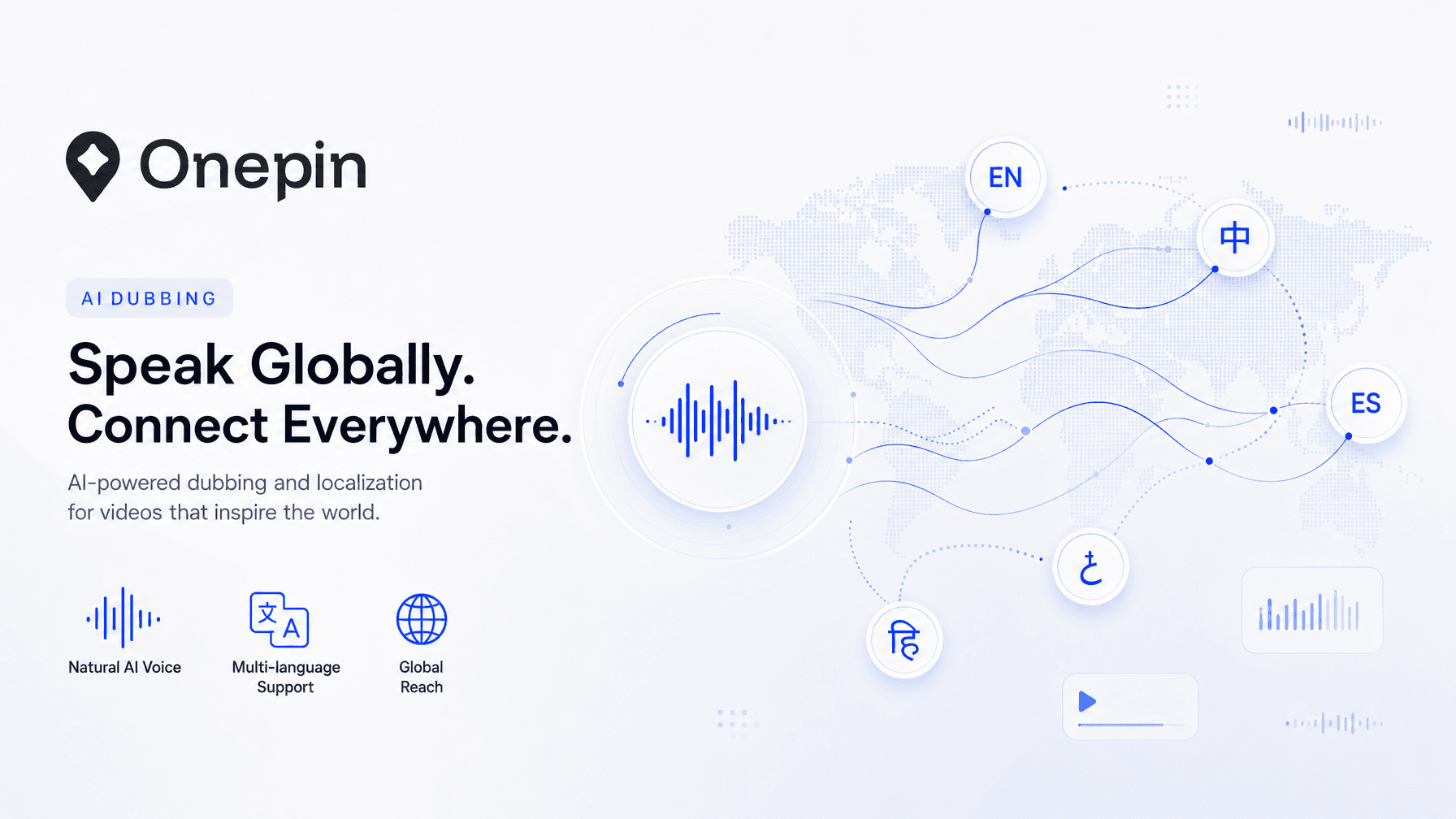
Onepin acts as an AI voice production agent that sits above 100+ text-to-speech models worldwide. Instead of locking video localization into one provider, Onepin automatically plans, validates, retries, and routes speech generation to the optimal voice engine for every specific language and speaker profile.
- Automated Pronunciation & Word Accuracy Checks: Onepin verifies audio output prior to delivery, detecting audio glitches or mispronunciations.
- Dynamic Model Fallbacks: If a primary TTS provider experiences latency spikes or errors, Onepin automatically routes requests to a secondary high-quality voice model.
- Unified Multilingual Pipeline: Orchestrate voice cloning, localized dubbing, and quality control from a single API integration.
Frequently Asked Questions
What is the most accurate AI dubbing tool for video creators?
Leading creators use platforms like ElevenLabs for expressive voice cloning and CAMB.AI for long-form content. For automated multi-model routing across 100+ voices, Onepin provides meta-orchestration to select the highest quality model per language.
How do you maintain voice consistency across translated languages?
Voice consistency is maintained using zero-shot or few-shot cross-lingual voice cloning models. These systems extract acoustic speaker embeddings from original audio recordings and apply those vocal characteristics to generated target-language speech.
Can AI dubbing adjust for different sentence lengths across languages?
Yes. Modern dubbing stacks utilize dynamic audio time-stretching, pauses, and context-aware machine translation to shorten or lengthen phrase timing so dubbing tracks align naturally with original video frames.
Accelerate Your Global Video Localization
Automating video dubbing unlocks instant global reach for creators, media companies, and software platforms. To ensure your multilingual audio maintains studio quality across every market without single-vendor lock-in, explore how Onepin orchestrates and validates AI voice production at scale.