AI Voice Actor: The 2026 Production Guide
#TLDR
An AI voice actor uses text-to-speech synthesis to produce human-sounding audio on demand. The generation step is solved. The production challenges (consistency across hundreds of clips, version locking, format compliance, and retake economics) are not. This guide covers both.
Hiring a human voice actor used to mean booking studios, managing schedules, and paying for every retake. AI voice actors changed that equation. Today, a production team can generate hours of publish-ready audio in minutes, in dozens of languages, at a fraction of the cost.
But teams shipping that audio at scale have discovered a second problem: generation is the easy part.
This guide covers what AI voice actors actually are, which tools lead the field in 2026, and what production teams need in place before they can reliably ship.
What Is an AI Voice Actor?
An AI voice actor is a text-to-speech (TTS) system trained to produce natural-sounding speech from written text. Modern systems can:
- Clone an existing human voice from a short audio sample
- Generate consistent character voices across thousands of clips
- Adjust tone, pacing, emphasis, and emotion through text prompts or audio references
- Produce output in 40+ languages without language-specific talent
The distinction between an AI voice actor and a basic TTS tool is quality. AI voice actors trained on large speech datasets produce natural prosody, breath patterns, and emotional range. They sound nothing like the robotic voice on a 2010 GPS unit.
Top AI Voice Actor Tools in 2026
| Tool | Best For | Voice Cloning | Languages | Pricing Model |
|---|---|---|---|---|
| ElevenLabs | Character voice, dubbing | Yes | 32+ | Per-character / subscription |
| Cartesia | Real-time voice agents | Yes | 20+ | API token-based |
| Deepgram | High-volume API, low latency | Limited | 35+ | Per-character |
| MiniMax | Multilingual, emotion range | Yes | 14+ | API-based |
| Rime AI | American English naturalness | Limited | English-primary | Per-character |
| WellSaid Labs | Enterprise brand voice | Yes | English-primary | Enterprise subscription |
Each tool excels in a specific context. ElevenLabs leads on voice quality and character range. Cartesia leads on latency for real-time agents. Deepgram handles volume at competitive pricing. MiniMax covers APAC-first production needs.
None of them ship production infrastructure. That part is yours to build.
4 Production Challenges AI Voice Actor Tools Don't Solve
1. Voice Consistency Across Hundreds of Clips
A single character in an audiobook or training module might span 500 clips across multiple sessions. The AI voice actor generates each independently. Without a reference profile locked to a specific model version and voice setting, clip 1 and clip 498 will drift, subtly or obviously.
Human voice actors are consistent because they're human. AI voice actors are consistent only if the pipeline enforces it.
2. Model Version Lock
TTS providers update their models regularly. When a provider ships a new version, voice characteristics change, sometimes slightly, sometimes significantly. If you generated 200 clips on model V2 and the provider auto-migrates to V3, your next batch sounds different from everything you've already shipped.
Most providers don't alert you when this happens. Some don't offer rollback options at all.
3. Quality Validation at Scale
Testing 10 hand-picked clips before launch is not quality assurance. A 2% mispronunciation rate across a 10,000-clip production batch means 200 clips that can't ship. Without automated scoring against a reference baseline, those 200 clips reach your audience or require a full re-run to find them.
4. Retake Economics
A 5% retake rate sounds manageable. At 10,000 clips, that's 500 unbudgeted pipeline runs, each with compute time, API costs, and review hours. Without per-clip quality scoring, you don't know which clips need retakes until someone listens to every one of them.
How to Choose the Right AI Voice Actor
Before picking a tool, answer four questions:
What's your clip volume? If you're shipping fewer than 50 clips a month, almost any tool works. Above 500 clips a month, automated quality validation and version locking become non-negotiable.
What languages do you need? English-primary tools like WellSaid and Rime produce exceptional quality in English. For Japanese, Korean, or Chinese at production quality, MiniMax or ElevenLabs with a multilingual model will serve you better.
Do you need real-time or batch? Real-time voice agents need sub-200ms latency. Cartesia and Deepgram lead here. Batch production (audiobooks, training modules, explainer videos) tolerates higher latency in exchange for better quality.
Do you need voice cloning or character voices? If you're replicating a specific person's voice, ElevenLabs and MiniMax offer production-grade cloning from short reference samples. If you need a library of distinct character voices, most major providers have voice marketplaces.
Why a Model-Agnostic Production Layer Matters
The AI voice actor tools listed above are generation layers. They answer one question: can this text become audio?
They don't answer: Is this audio ready to ship? Is it consistent with what you generated last month? Does it meet format specs for your target platform? If it fails, do you know exactly which clip failed and why?
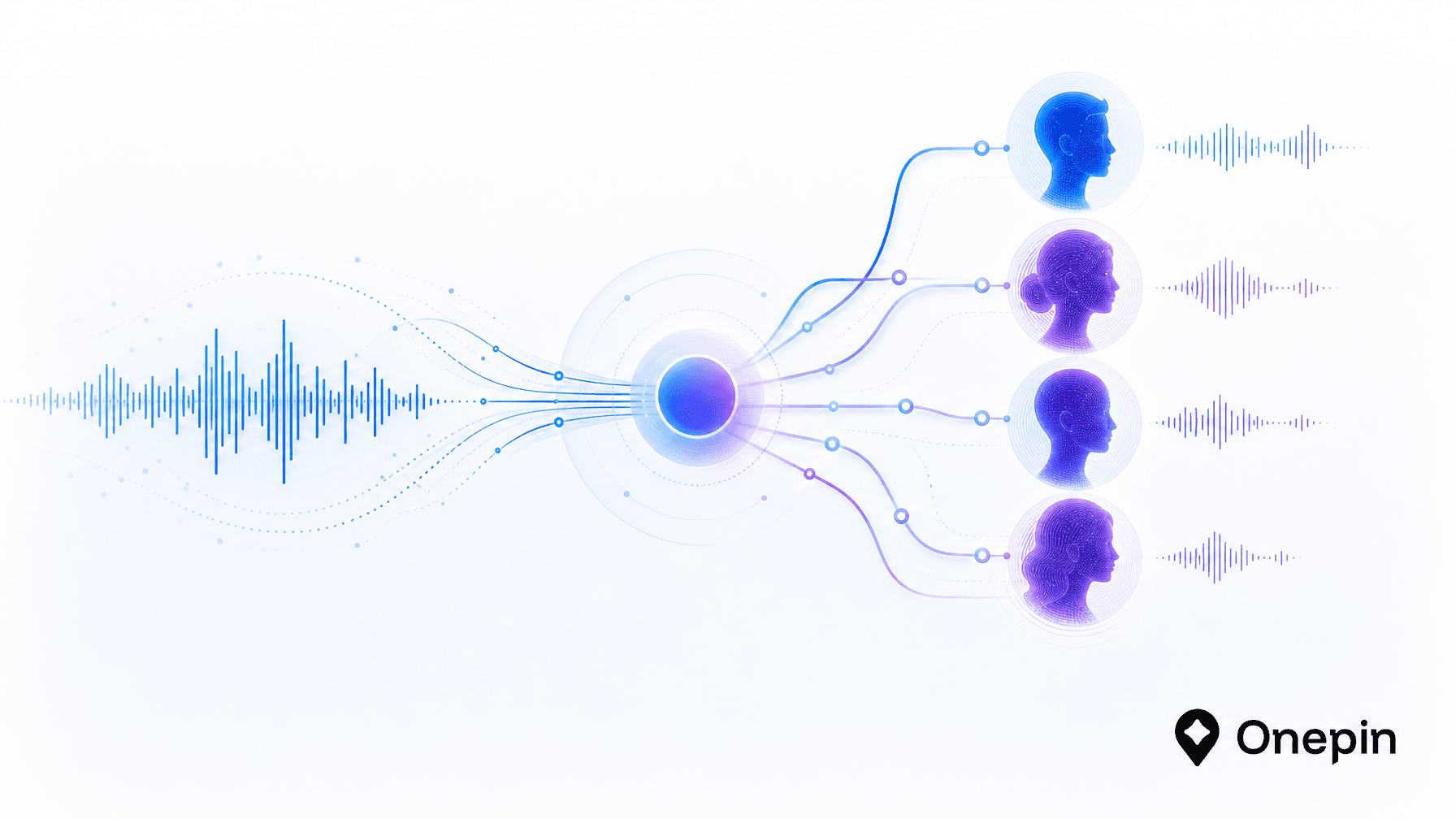
Onepin is the production layer that sits above these models. It routes each request to the best-fit voice model, runs automated quality validation against a reference baseline, enforces version locking so clips stay consistent across model updates, and handles retries without manual intervention.
The result: your team picks the voice actor, AI or cloned, and Onepin handles everything from generation to a quality-stamped, format-compliant output file ready to hand off.
That also means you're not locked into a single AI voice actor provider. If ElevenLabs raises prices, Cartesia ships a better model for your language, or a provider has an outage, Onepin reroutes without a pipeline rebuild.
Ready to Ship AI Voice at Scale?
The generation problem is solved. The production problem (consistency, version locking, quality validation, and retake economics) is what stops teams from shipping at volume.
Onepin handles the production layer so your team ships quality-stamped audio instead of monitoring individual clips. See how it works at onepin.ai/docs.
Frequently asked questions
- What is an AI voice actor?
- An AI voice actor is a text-to-speech system trained to produce human-sounding speech from written text. Modern AI voice actors can clone existing voices, generate audio in dozens of languages, and deliver output at a quality level suitable for commercial production including audiobooks, explainer videos, and voice agents.
- Can AI voice actors replace human voice actors?
- For high-volume, script-driven content, AI voice actors are already the production standard. For nuanced creative performance (character acting, emotional narrative, and improvisation), human voice actors still lead. Most production teams deploy AI voice actors where consistency and volume matter, and human talent where creative range is the priority.
- How much do AI voice actors cost?
- Pricing varies by provider and volume. Character-based pricing typically runs from $0.006 to $0.03 per 1,000 characters depending on the model and tier. Subscription plans for teams range from $99 to $330 per month for moderate volumes, with enterprise contracts priced separately for high-volume production.
- What is the difference between an AI voice actor and a TTS tool?
- A standard TTS tool converts text to audio. An AI voice actor is a TTS system specifically optimized for natural, human-sounding delivery with trained prosody, breath patterns, and emotional range. In 2026, the best AI voice actor tools produce output that is difficult to distinguish from human recordings in controlled listening tests.
- How do I maintain voice consistency when using an AI voice actor at scale?
- Consistency requires locking the voice profile to a specific model version and running automated quality validation against a reference baseline for every clip. Without version locking, provider model updates silently change your voice characteristics between batches. A production orchestration layer like Onepin enforces both version locking and automated QA across all clips.