AI Voice for Logistics: The 2026 Production Guide
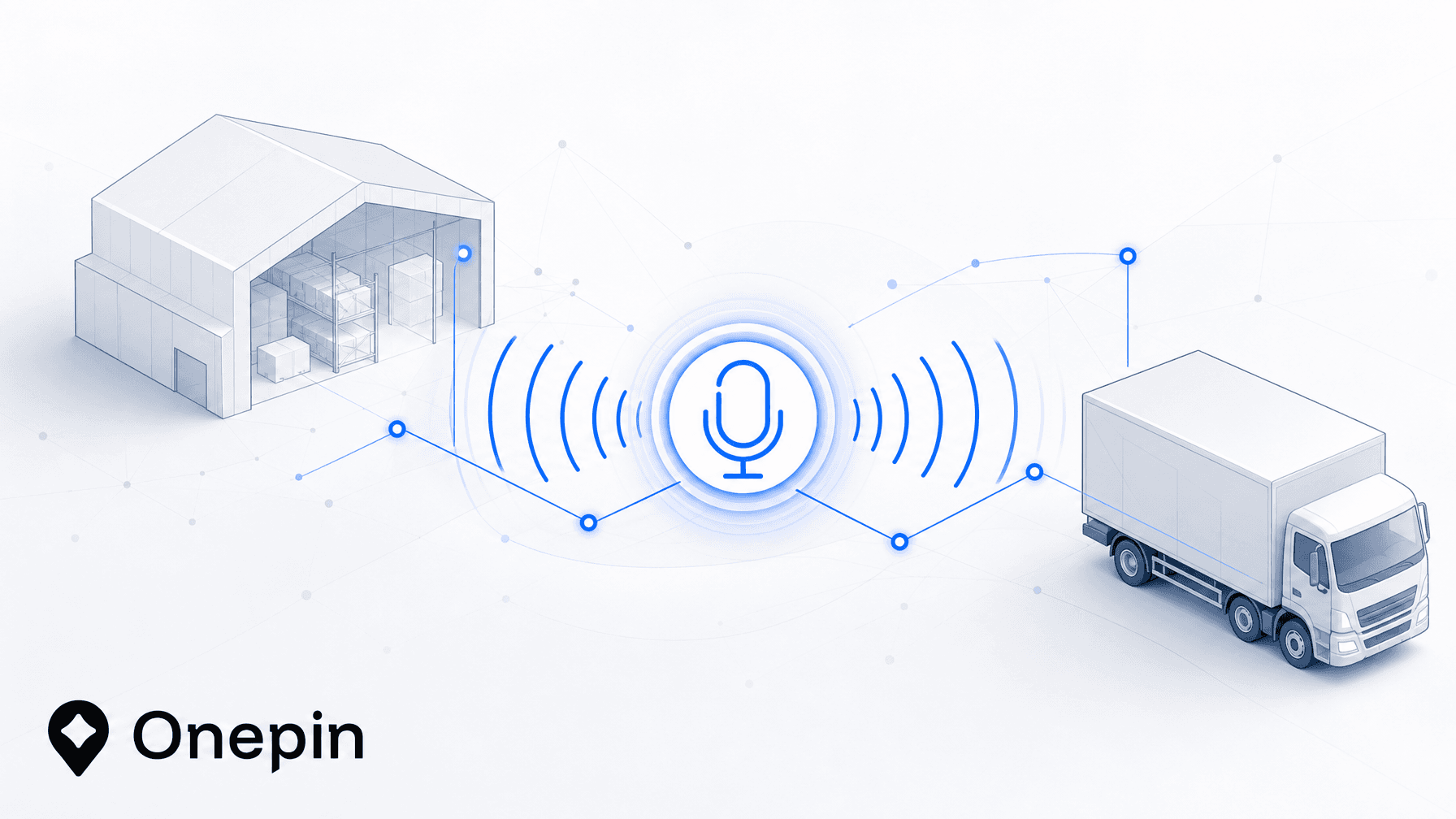
AI voice for logistics refers to text-to-speech systems that generate spoken audio for warehouse operations, driver dispatch, delivery notifications, and fleet communications. The core challenge is production reliability: a driver who hears a mispronounced street name has no visual fallback, and warehouse PA systems require specific audio formats that most TTS APIs do not deliver by default. Teams that skip the production layer above their TTS model ship audio that generates rather than validates.
What do logistics teams actually use AI voice for?
Logistics deployments break into four use cases, each with distinct quality requirements.
Warehouse PA announcements. Picking instructions, safety alerts, shift assignments, and equipment status updates play through PA hardware with specific codec and loudness requirements. Volume consistency matters: a clip 6dB louder than adjacent clips creates noise hazards and violates occupational safety guidelines.
Driver dispatch instructions. Turn-by-turn navigation, load assignment updates, route deviations, and delivery window alerts all pass through TTS. Street names, intersection names, cargo identifiers, and location codes must pronounce correctly. A mispronounced address sends a driver to the wrong location. There is no screen to catch the error at highway speed.
Last-mile delivery notifications. Customer-facing automated calls and voice clips for delivery ETAs, door code instructions, and pickup confirmations. Voice consistency across thousands of daily notifications determines brand perception at the final touchpoint.
Multilingual fleet communications. Global logistics operations serve drivers across multiple languages. A distribution network running drivers in English, Spanish, Portuguese, and Mandarin needs validated TTS output in each language, not just a model that claims multilingual support.
What are the 4 production failures that break logistics voice AI deployments?
Production failures in logistics voice AI carry immediate physical consequences. A warehouse worker who mishears a picking instruction creates an inventory error. A driver who hears a wrong address wastes fuel and misses a delivery window.
Failure 1: Address and cargo identifier mispronunciation. TTS models trained on general text corpora do not reliably pronounce logistics-specific vocabulary. Street suffixes like "Blvd" and "Pkwy," abbreviated cargo codes, warehouse aisle identifiers such as "A-14L," and regional address formats all produce unexpected phoneme output. A 2% mispronunciation rate across 10,000 daily dispatch instructions means 200 incorrect routing events per day. That is a production problem, not a model selection problem.
Failure 2: Voice drift across dispatch points. A logistics network with 50 regional dispatch hubs may run different TTS model versions due to provider auto-migration. Drivers who rotate between regions hear inconsistent voices. More critically, a model update in one region changes pronunciation of shared vocabulary without triggering a quality review. Version locking prevents this, but TTS APIs do not apply version locks by default.
Failure 3: Silent multilingual quality failures. Most TTS validation happens on the primary language: English for North American networks, Mandarin for APAC operations. Regional fleet communications in secondary languages ship on assumption. No validation pipeline runs on the Spanish-language version of the same dispatch instruction. When a model produces a fluent-sounding but phonemically incorrect output in a secondary language, no one catches it until a driver reports confusion. By then, the clip has been playing for weeks.
Failure 4: Audio format non-compliance for warehouse and vehicle hardware. Warehouse PA systems and vehicle intercom hardware require specific audio specifications that most TTS APIs do not deliver by default. Common requirements include 8kHz or 16kHz sample rates, G.711 codec for intercom systems, PCM for PA hardware, loudness normalization to a consistent target (typically -18 LUFS for indoor environments), and silence padding at clip boundaries to prevent hard cuts. A TTS API returning 24kHz MP3 requires conversion, normalization, and format validation before delivery. Skipping this step produces distorted or clipped audio that the hardware cannot process correctly.
How do you validate AI voice output at logistics scale?
Validation at logistics scale requires a production layer that runs automatically on every generated clip, not on a sample reviewed before launch.
The pipeline covers four checks:
Pronunciation validation. Every address component, cargo identifier, and location code in the dispatch vocabulary gets a stored reference pronunciation. Each generated clip is aligned against the reference. Deviations above a set threshold trigger automatic regeneration.
Acoustic consistency. Neural quality scoring assigns a score to every clip. Clips below threshold regenerate automatically. Batch-level score distributions get compared against a stored baseline to detect model drift after a provider update.
Format compliance. Every clip passes through a format validator that confirms sample rate, codec, loudness, and silence padding match the delivery specification for the target hardware. Clips that fail format validation get converted and re-validated before delivery.
Version integrity. The model version used for each generation is logged. When a provider updates their model, the pipeline compares new output against the stored baseline and alerts before the updated model reaches production.
This pipeline converts a manual listening task into a data pipeline that scales linearly with output volume. For a network generating 50,000 dispatch clips daily, the alternative is listening to 500 samples and hoping the failures are not in the 49,500 you did not hear.
Why do logistics teams switch from single TTS models to a voice AI platform?
Logistics teams that start with a single TTS model from ElevenLabs, Deepgram, Cartesia, or MiniMax hit the production ceiling when they try to enforce consistent quality across a multi-region, multi-language, multi-hardware network. Each of those models generates reliable audio. None of them validates output, locks versions, enforces format compliance, or retries failed clips automatically.
Switching to a voice AI platform decouples model selection from production operations. The platform handles validation, version locking, format conversion, retry logic, and audit trail. The TTS model handles synthesis. When a provider updates their model or a better option emerges for a specific language pair, the platform swaps the model without rearchitecting the production pipeline.
Onepin is a voice workflow platform that orchestrates, validates, and ships production-ready audio across 100+ TTS models. For logistics teams, that means every dispatch instruction passes pronunciation validation, every clip meets hardware format requirements, every regional language gets the same quality gate as the primary language, and every model version update gets caught before it reaches a driver. The production layer is what the model does not provide. Learn more at onepin.ai.