AI Voice Generator for Localization Teams: The 2026 Production Guide
TLDR
Global video localization demands high-quality, multilingual voiceover synthesis without the delays and costs of traditional dubbing studios. While modern text-to-speech (TTS) models generate convincing audio, relying on a single AI voice generator creates severe quality vulnerabilities across non-English languages. Localization teams require an orchestration layer to route scripts to the optimal voice model per target language, automatically validate pronunciation accuracy, and maintain brand consistency globally.
What is an AI voice generator for localization?
AI voice generation for localization is the automated process of converting translated text scripts into natural, broadcast-quality audio across global languages. The core challenge for enterprise content teams is maintaining pronunciation accuracy, natural pacing, and cultural voice fidelity across every market. Teams that deploy a centralized voice workflow platform eliminate single-model quality bottlenecks and scale global video production effortlessly.
According to a report by Fortune Business Insights, the global language services market is projected to reach $81.45 billion in 2026. Simultaneously, research from Grand View Research highlights that the AI video market will grow from $5.5 billion in 2026 to $42.3 billion by 2033 at a 32.2% CAGR. As organizations produce more video content for international audiences, manual voice recording cannot keep pace with localized media publishing schedules.
How do localization teams select an AI voice generator?
Selecting an AI voice generator requires evaluating language coverage, pronunciation precision, emotional cadence, and API stability across target distribution channels. Localization leads must evaluate how specific voice engines handle regional accents, technical terms, and pitch variations.
When building a commercial dubbing strategy, teams evaluate five critical criteria:
- Multilingual Accent Depth: Synthetic voices must sound native to local speakers rather than adopting an artificial foreign accent.
- Pronunciation Accuracy: Specialized industry terminology, proper nouns, and heteronyms require exact phonetic handling.
- Pacing and Video Synchronization: Localized speech must match source media timing without distorting pitch.
- API Throughput: Enterprise workflows demand batch audio generation to synthesize hundreds of video hours simultaneously.
- Model Diversity: Leading tools like ElevenLabs excel at emotional storytelling, Deepgram delivers ultra-low latency, Cartesia provides real-time streaming, and Rime AI offers specialized expressive voices.
Why is single-model lock-in a risk for multilingual video localization?
Single-model lock-in occurs when a localization pipeline relies on a single text-to-speech engine that performs unevenly across different regional languages. No single AI voice model maintains top-tier voice quality across all 100+ commercial languages worldwide.
Market analysis from Market.us indicates that the AI-powered dubbing market is expanding at a 21.3% CAGR. Furthermore, Market.us notes that e-learning platforms saw a 40% increase in video localization demands as global remote learning expanded.
Relying on one vendor creates three distinct failure modes:
- Quality Variance Across Languages: A model with high satisfaction in English may drop significantly in Japanese or Arabic, producing robotic artifacts.
- Vendor Lock-in: Single-vendor dependency leaves production teams vulnerable to sudden pricing changes or service outages.
- Lack of Quality Gates: Standard TTS APIs return raw audio bytes regardless of audio clipping or dropped words.
How does Onepin orchestrate multilingual voice workflows at scale?
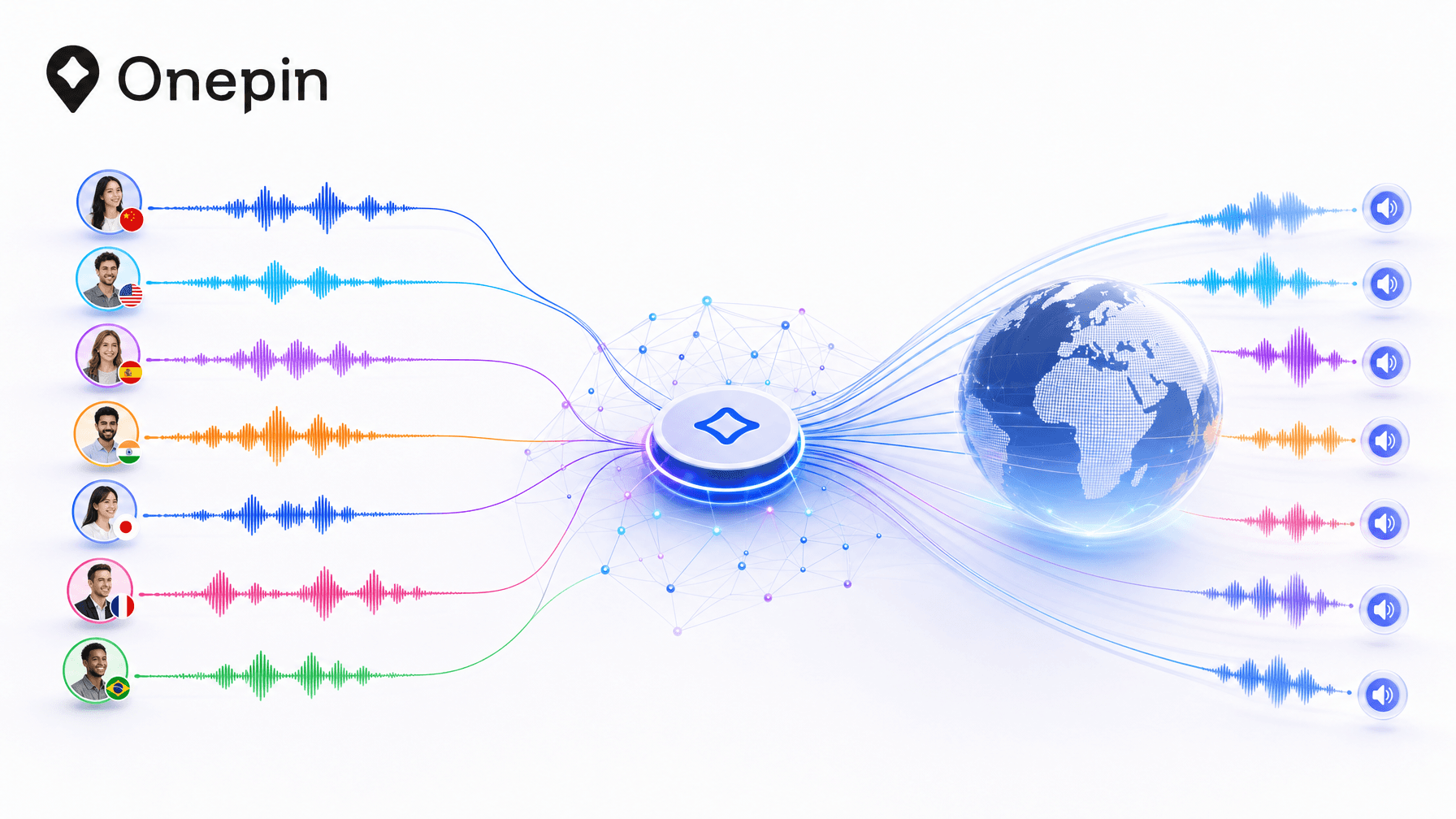
Multilingual voice orchestration automates model selection, audio validation, and retry logic across multiple text-to-speech providers in a single unified API pipeline. Instead of managing 10 different voice provider APIs, an orchestration layer provides a central hub for global audio production.
Onepin is a voice workflow platform that orchestrates, validates, and ships production-ready audio across 100+ TTS models.
By placing an intelligent production layer between translated scripts and underlying TTS engines, Onepin solves core enterprise voice dubbing challenges:
- Automated Language Routing: Onepin automatically directs each translated script to the highest-scoring voice model for that specific target language.
- Pronunciation and Quality Validation: The platform inspects generated audio against ground-truth scripts, detecting mispronunciations or audio artifacts before delivery.
- Automatic Retries and Fallbacks: If a primary model produces sub-par audio quality, Onepin instantly re-synthesizes the segment using an alternate top-ranked voice model.
- Enterprise Workflow Integration: Content creators and localization management systems connect through one clean SDK to generate, validate, and ship multi-track audio.
Best Practices for Scaling AI Voice Generation in 2026
To achieve broadcast-quality localized video without ballooning operational overhead, localization leads should adopt three core workflow principles:
- Decouple Script Translation from Audio Synthesis: Ensure translations are culturally adapted before audio generation.
- Implement Automated Audio QA: Establish automated quality gates that verify audio duration, loudness normalization, and word accuracy.
- Build on a Meta-Orchestration Layer: Avoid hardcoding single-vendor TTS APIs into your codebase to maintain flexibility as new models enter the market.
Conclusion
Localizing video content for global audiences no longer requires weeks of expensive dubbing studio sessions. Modern AI voice generators produce highly realistic speech, but true enterprise scale requires more than raw text-to-speech synthesis. By moving beyond single-model dependencies and adopting an automated voice orchestration platform like Onepin, localization teams guarantee consistent voice quality, zero vendor lock-in, and flawless audio delivery across every market.