ByteDance Just Promised One Model for Every Sound. Production Reality Is More Complicated.
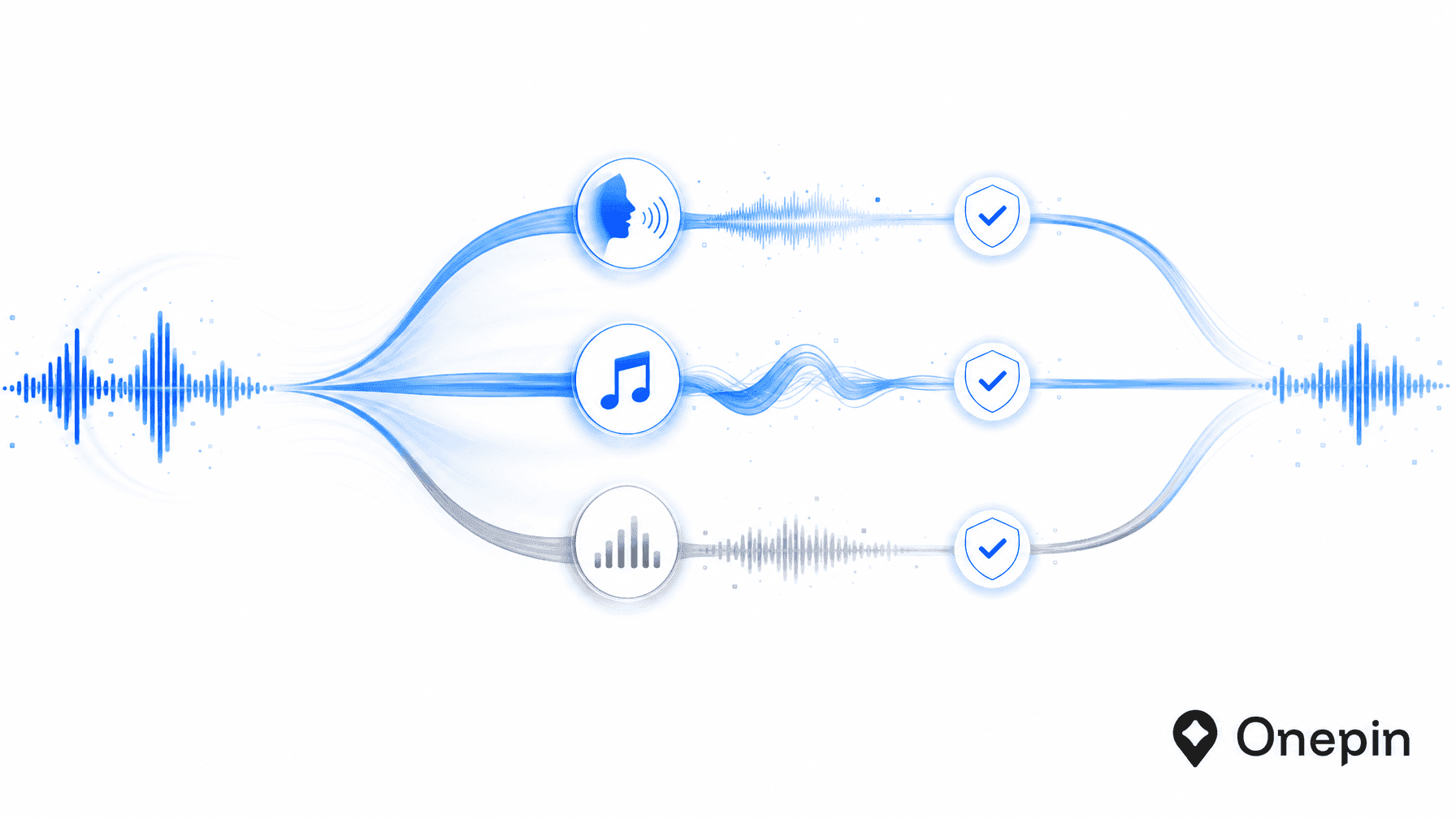
At its Volcano Engine FORCE conference on June 23, 2026, ByteDance unveiled Seed Audio 1.0, a universal audio generation model that claims to produce voices, music, sound effects, and ambient soundscapes simultaneously in a single generation pass. The pitch: describe a scene in text, and the model outputs broadcast-quality audio with no mixing or post-production required. One model. Every sound. Done.
It is an impressive technical achievement. ByteDance's Seed team built something genuinely new: a model that understands audio as a complete scene, not just a text reading exercise. Seed Audio 1.0 handles multi-character dialogue, emotional inflection, background score, Foley sounds, and environmental ambience all at once. For a content creator building a short-form video in CapCut, that is transformative.
For teams running audio at production scale, the announcement raises a different set of questions entirely.
The Generation Promise and the Production Gap
Every major audio AI launch in 2026 has carried the same headline: model X generates broadcast-quality audio, no studio required. ElevenLabs said it. Cartesia said it. Deepgram said it. Now ByteDance says it with Seed Audio 1.0.
The claim is accurate at the level of a single generation. The problem is that production-scale audio delivery is not a single generation. It is 10,000 generations, across dozens of use cases, over months, with model updates happening in the background, quality variance across clip lengths, and business consequences attached to each output.
ByteDance's own documentation notes that Seed Audio 1.0 will receive "continuous model updates" via Volcano Engine. That sentence is written as a selling point. In production environments, it is a risk statement.
When a model updates silently, validated audio profiles break without warning. A character voice that cleared QA last Tuesday may sound subtly different after the update. Brand names may be mispronounced at the new model's rate, not the rate your team approved. The generation still completes. The output file still exists. But the clip is no longer what you shipped to production last week.
What "No Post-Production Needed" Actually Means at Scale
Seed Audio 1.0's core pitch (one generation pass, no mixing required) solves a real pain point for individual creators. It does not solve the production infrastructure problem that enterprise teams face.
Consider the layers Seed Audio does not address:
Per-clip validation. When you generate 5,000 clips for a podcast network, a game, or a corporate training library, you need a systematic way to confirm each clip meets your quality baseline. A model that generates confidently is not the same as a model whose output has been verified. Confidence scores at generation time do not measure pronunciation accuracy, acoustic drift, or format compliance.
Model version locking. A production audio pipeline needs to know exactly which model version produced each clip. ByteDance's continuous update schedule means Seed Audio 1.0 today is not Seed Audio 1.0 in three months. Without version tracking, you cannot reproduce a clip, audit a failure, or roll back to a known-good state after a model update changes your output profile.
Retry economics. When a clip fails quality validation (mispronounced brand name, incorrect emotion tag, format non-compliance), you need a rule-based retry system that knows when to re-generate, when to escalate, and what the cost of each decision is. Manual QA at 5,000 clips does not scale. Neither does re-running an entire batch because you cannot isolate which clips failed.
Failover routing. If Seed Audio 1.0's API is unavailable or returns degraded output quality, what happens to your pipeline? One-model architectures have one failure point. A production-grade voice pipeline routes to a fallback model automatically, maintains quality SLAs, and logs every reroute decision for audit.
The Industry Pattern That Keeps Repeating
The AI voice industry in 2026 has become very good at generation. MiniMax, Rime AI, Inworld, and now ByteDance are all producing models with genuinely impressive output quality. The TTS leaderboard at the top has compressed to the point where the top models sit within a few Elo points of each other.
What the industry has not solved is the production layer above the model. The layer that validates, routes, retries, versions, audits, and ships audio that meets a defined quality standard at scale. That layer does not come bundled with Seed Audio 1.0. It does not come with any TTS model, regardless of how good the demos sound.
ByteDance's FORCE conference announcement confirms what the market already knew: generation quality is no longer the differentiator. The differentiator is the infrastructure you build above the model: the part that makes generation quality reproducible, auditable, and scalable across real production workloads.
What a Production Pipeline Actually Requires
Teams scaling audio production need four things that Seed Audio 1.0 (and every other model launch) does not provide out of the box:
Quality validation per output. Every generated clip needs a pass/fail score against defined thresholds: pronunciation accuracy, acoustic consistency, format compliance, duration. Not sampled QA. Per-clip QA, automated.
Model version locking and tracking. Every clip in your library needs a model version signature. When Seed Audio 1.0 updates, you need to know which clips were generated on which version, so you can scope the impact and run targeted re-validation rather than re-generating everything.
Intelligent failover routing. No single model should be a single point of failure. A production pipeline routes between models based on quality thresholds, language requirements, latency budgets, and cost, automatically, without manual intervention.
Audit trail. Every generation decision (model version, quality score, retry count, failover event) needs to be logged. In regulated industries, this is a compliance requirement. In any production context, it is the only way to diagnose failures after they reach users.
These are not features you build once. They are the ongoing operational layer that sits above every model you use, whether that model is Seed Audio 1.0, ElevenLabs, Cartesia, or all three running in parallel.
The Right Way to Read the Seed Audio Launch
ByteDance's entry into universal audio generation is genuinely significant. Seed Audio 1.0 raises the ceiling on what a single model can produce. It will accelerate adoption of AI audio across content creation, gaming, advertising, and enterprise voice applications.
What it does not do is collapse the distance between generation and production. That gap is wider than any single model launch can close, because the gap is not a model quality problem. It is an infrastructure problem.
The teams that win with Seed Audio 1.0 will treat it as one node in a managed pipeline, not a complete solution. They will validate every output, lock every version, route around failures, and audit every decision. The model handles generation. The production layer handles everything that comes after.
Onepin is that production layer, a meta-orchestration and validation platform that runs above Seed Audio 1.0 and 100+ other TTS models. If you are scaling audio production and want a pipeline that validates, routes, retries, and ships publish-ready audio, start here.
Frequently asked questions
- What is ByteDance Seed Audio 1.0?
- It is a universal audio generation model ByteDance unveiled at its Volcano Engine FORCE conference on June 23, 2026. It aims to produce voices, music, sound effects, and ambient soundscapes in a single generation pass, handling multi-character dialogue, emotional inflection, background score, Foley sounds, and environmental ambience all at once.
- Why do continuous model updates create risk in production?
- ByteDance documents that Seed Audio 1.0 will receive continuous updates via Volcano Engine. When a model updates silently, validated audio profiles can break without warning: a character voice that cleared QA may sound subtly different, and brand names may be mispronounced. The generation still completes, but the clip is no longer what you shipped previously.
- What does no post-production needed miss at production scale?
- The one-pass pitch solves a real pain point for individual creators but not the infrastructure enterprise teams face. Production scale is thousands of generations across dozens of use cases, requiring per-clip validation, model version locking, retry economics, and failover routing. Confidence at generation time does not measure pronunciation accuracy, acoustic drift, or format compliance.
- What does a production pipeline require beyond the model?
- The post describes four needs: quality validation per output, model version locking and tracking, intelligent failover routing, and an audit trail. These are not one-time features but an ongoing operational layer that sits above every model, whether Seed Audio 1.0, ElevenLabs, or Cartesia.
- How does Onepin relate to Seed Audio 1.0?
- The post positions Onepin as a meta-orchestration and validation platform that runs above Seed Audio 1.0 and 100-plus other TTS models. It validates every output, locks every version, routes around failures, and ships publish-ready audio, treating the model as one node in a managed pipeline rather than a complete solution.