Flux TTS: 80ms Latency, 2.2% WER, Still Unvalidated
Deepgram launched Flux TTS today, calling it the first conversation-native text-to-speech model built for real-time voice agents. The model maintains context across an entire call instead of resetting every turn. It begins responding in as low as 80 milliseconds, handles interruptions natively, and carries tone and pacing forward from one exchange to the next.
The company, which recently surpassed $100 million in annual recurring revenue, positions Flux TTS as the speaking layer for production voice agents. Companies including Decagon, Sierra, Vapi, and Granola already run on Deepgram's voice infrastructure. IBM's watsonx Orchestrate and Coval's voice agent evaluation platform are early Flux TTS adopters.
Flux TTS is a genuine architectural advance. It also leaves the hardest production problem untouched.
What does conversation-native TTS actually solve?
Conversation-native TTS solves the generation side of voice agents. Traditional TTS treats every request as a standalone narration job: text in, audio out, context gone. Flux TTS replaces that with a Mamba state-space backbone that holds conversational context across the entire session without the quadratic cost of transformer architectures.
Three things improve immediately. Tone no longer resets every turn, so a warm opening stays warm at minute ten. Developers stop hand-feeding SSML tags, style markers, and prompt engineering to compensate for a model that cannot read the room. And interruptions resolve cleanly because the server reports exactly what the caller heard before the barge-in.
Deepgram reports a median word error rate of 2.2%, roughly half of ElevenLabs and a third of Cartesia. On hard prompts, the kinds that surface in production (alphanumerics, drug names, policy IDs, dollar amounts), Flux TTS hits 3.4% WER, beating the next-best model by 47%.
These are real improvements. They describe how the model generates. They do not describe whether each output is correct.
Why does 2.2% word error rate still matter at scale?
A 2.2% median WER is the best published number for any read-aloud TTS model in 2026. It is also 2,200 errors per 100,000 outputs. For a voice agent handling 50,000 calls per day, that is over 1,000 clips where the account number, the dollar amount, the medication name, or the callback number comes out wrong.
According to McKinsey's 2026 State of AI report, AI-powered customer service resolutions cost $0.62 versus $7.40 for human agents. That cost advantage disappears when a mispronounced dosage triggers a callback, a wrong account number forces escalation, or a misread policy ID generates a compliance incident.
The median WER describes the model's average performance on a benchmark set. Production quality lives in the tail: the specific proper nouns, the alphanumeric strings, the domain vocabulary that the benchmark never tested. A 2.2% average can hide a 15% error rate on the terms that carry the most consequence.
Deepgram's own blog acknowledges this directly: "For businesses in healthcare, finance, and insurance, a voice agent lives or dies on the details: the drug name, the account number, the policy ID, the dollar amount." The model is built to handle them better. But "better" and "validated" are two different guarantees.
What is the gap between generation quality and production readiness?
Generation quality measures how well a model converts text to speech on average. Production readiness requires four guarantees that no TTS model provides on its own.
Per-output pronunciation validation. A locked pronunciation dictionary for domain vocabulary (drug names, brand names, financial terms, street addresses) with every output scored against it before reaching the caller. Flux TTS improves entity accuracy on average. It does not score individual outputs against a reference.
Model version locking. Flux TTS ships as a generally available model today. When Deepgram updates it, every voice agent running Flux TTS gets the new version. There is no mechanism to pin a validated version, roll back if quality regresses, or even detect that the model changed. According to Forrester's 2026 Voice AI Wave, voice AI now handles 19% of inbound contact center volume, up from 6% in 2024. Silent model updates at that scale affect millions of calls.
Per-output quality scoring. Flux TTS generates audio. Nobody scores the generated audio against a locked reference before it plays to the caller. The conversation-native architecture ensures the tone stays consistent. It does not ensure the content stays correct.
Audit trail. Regulated industries (healthcare, finance, insurance) require provenance for every piece of information communicated to a customer. Which model version generated this clip? What was the input text? Did the output pass validation? Flux TTS generates the audio. The audit infrastructure is someone else's problem.
How does Onepin close the output validation gap?
Onepin is a voice workflow platform that orchestrates, validates, and ships production-ready audio across 100+ TTS models. It sits above any TTS model, including Deepgram Flux TTS, and owns the four guarantees the model cannot provide.
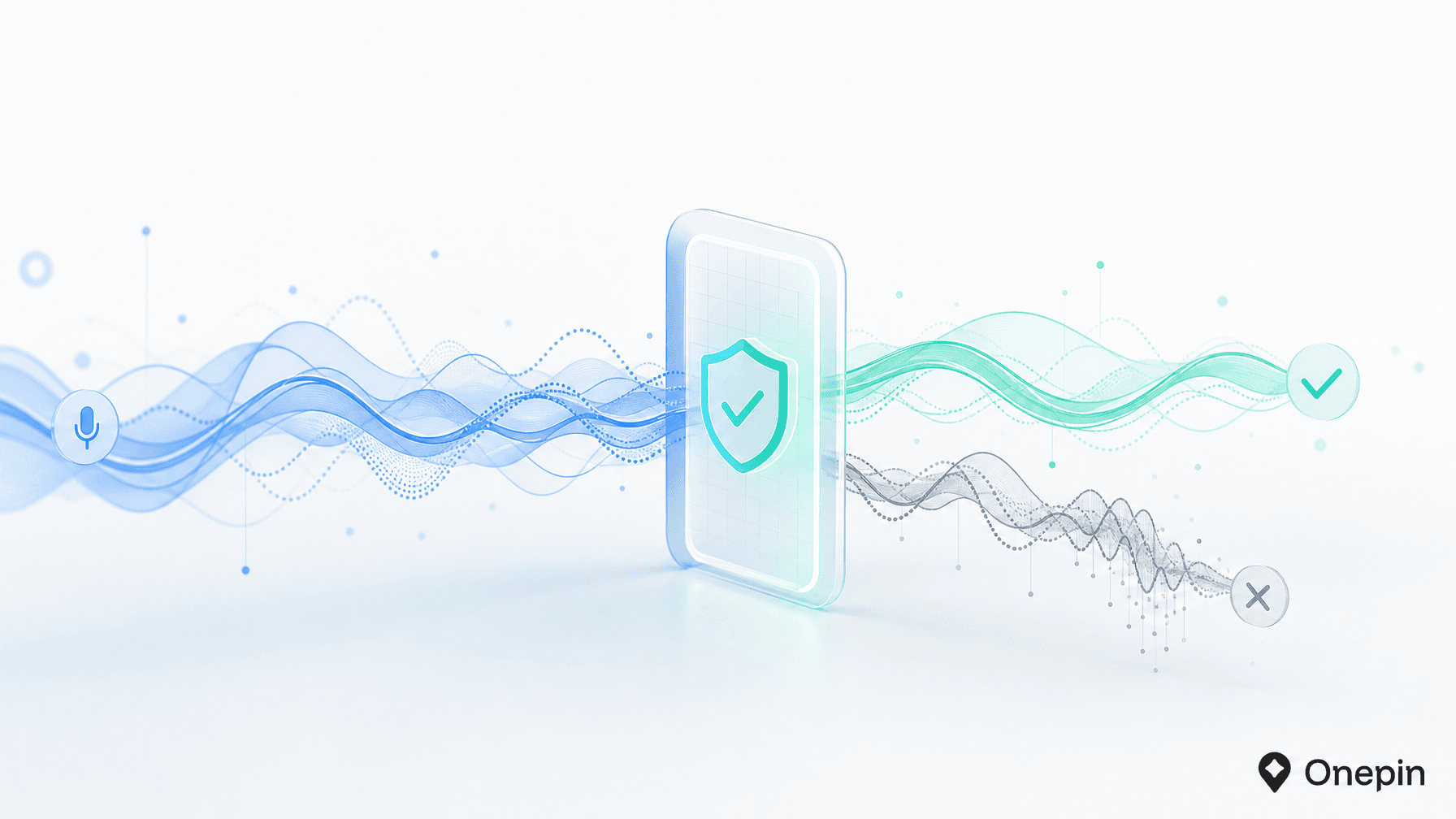
Onepin locks a pronunciation reference per language and domain, scores every output against it, pins the validated model version, and regenerates only the clips that fail. The model handles generation. Onepin handles validation.
Flux TTS makes the generation layer meaningfully better. The tone holds. The latency drops. The expressiveness improves without SSML. These are real wins for developers building voice agents.
But a conversation-native model that generates better audio is still a model that generates audio. It is not a system that validates audio. The account number that comes out wrong at minute eight of a consistent, expressive, low-latency conversation is still wrong.
Generation quality went up today. The validation gap stayed exactly where it was.
Frequently asked questions
- What is Deepgram Flux TTS?
- Deepgram Flux TTS is a conversation-native text-to-speech model launched in August 2026. It maintains context across an entire voice agent conversation instead of resetting every turn, producing more expressive and consistent speech with time-to-first-audio as low as 80ms.
- Does conversation-native TTS eliminate pronunciation errors?
- No. Deepgram reports a median word error rate of 2.2%, which is the lowest among read-aloud TTS models tested. But at production volume, even 2.2% means thousands of incorrect outputs per day. Conversation-native generation improves average quality without guaranteeing per-output correctness.
- What is the difference between conversation-native TTS and output validation?
- Conversation-native TTS improves how audio is generated by maintaining context across turns. Output validation checks each generated clip against a reference for pronunciation accuracy, voice consistency, and format compliance before it reaches a listener. They solve two different problems.
- How does Onepin work with conversation-native TTS models like Flux?
- Onepin is a voice workflow platform that orchestrates, validates, and ships production-ready audio across 100+ TTS models. It sits above any TTS model, including Flux TTS, to score every output against a locked reference, catch errors before they reach callers, and route to the best model per workload.
- Is Deepgram Flux TTS free to use?
- Deepgram offers Flux TTS free through September 12, 2026 with up to 45 concurrent streaming connections globally. Standard pricing applies after that date.