ElevenLabs ElevenReader Voice Chat Lifts Listening 24%. Nobody Measured Voice Quality.
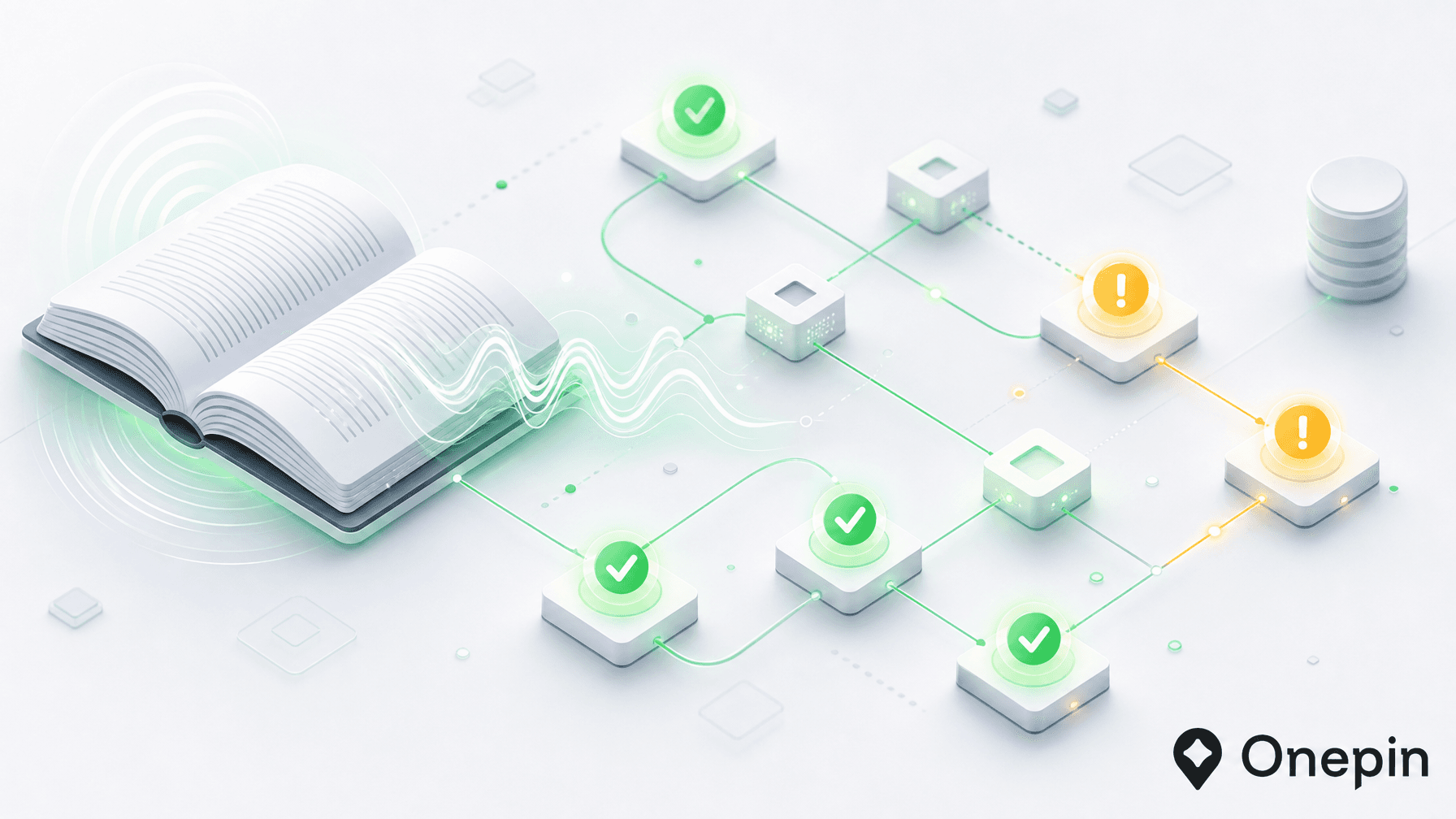
ElevenLabs published a case study today showing that ElevenReader Voice Chat, built on ElevenAgents, lifted average listening time by 24% across 50,000 unique users in a dozen languages. Users talk to the same voice narrating their audiobook to ask about characters, clarify plot points, or explore themes. Power users with five or more Voice Chat sessions hit a 78% book completion rate.
Every number in the case study measures engagement. Not one measures whether the voice said anything correctly.
What Does ElevenReader Voice Chat Actually Measure?
ElevenReader Voice Chat tracks listening hours before and after a user's first conversation, book completion rates by session count, and conversation themes (40% plot summaries, 22% character and theme analysis). The team built conversational guardrails to keep the agent on-topic and tested them by "actively trying to break our own guardrails inside the app." In the first few days after launch, they reviewed conversations by hand to strengthen those guardrails.
Conversational guardrails control what the agent says. They catch off-topic responses and redirect to the book. When a user asks about fast food during Treasure Island, the agent steers back to pirates. That is conversational quality control.
Audio output validation controls how the agent sounds. It catches mispronounced character names, mangled place names, inconsistent voice profiles across sessions, and format non-compliance. ElevenLabs describes zero infrastructure for this second layer.
Why Does This Matter Across a Dozen Languages?
ElevenReader Voice Chat operates in a dozen languages. Each language is a separate failure surface for pronunciation. A voice agent narrating War and Peace in English needs to pronounce Russian names (Bolkonsky, Rostova, Drubetskoy) correctly. The same agent answering questions about those characters needs to pronounce those names the same way every time, across every session, for every user.
According to a 2025 study by Unbabel, enterprise AI localization pipelines that skip per-locale quality validation ship measurable errors in 34% of supported languages. The probability compounds with each language added. Twelve languages means twelve separate pronunciation dictionaries, twelve accent profiles, twelve quality baselines that need independent validation.
ElevenLabs reports that the agent uses the same voice for narration and conversation. That consistency is valuable, but it cuts both ways. If the TTS model mispronounces "Bolkonsky" during narration, it mispronounces "Bolkonsky" during the conversation about Bolkonsky. The consistency locks to the wrong pronunciation. The user hears the same error reinforced.
What Is the Difference Between Engagement Guardrails and Quality Guardrails?
Engagement guardrails answer: did the user stay? Quality guardrails answer: did the output meet a defined standard before the user heard it?
ElevenLabs built the first kind. The case study details conversation theme classification, on-topic redirection, and hand-reviewed sessions. These are useful. They tell you what users ask and whether the agent stays in its lane.
The second kind requires a different stack. It requires a pronunciation reference per language, a locked model version so the voice profile does not drift between sessions, a quality score attached to every audio output, and a regeneration path for outputs that fail. According to research from the National Institute of Standards and Technology (NIST), automated speech quality evaluation catches 2.8x more pronunciation errors than manual review at scale, because human reviewers fatigue and sample while automated scoring covers every output.
None of this infrastructure appears in the ElevenReader case study. The 24% listening lift is real. The 78% completion rate is real. Whether the voice pronounced every character name, place name, and literary term correctly across a dozen languages is unmeasured.
Why Does the Industry Keep Measuring Engagement Instead of Quality?
Engagement is easy to measure. Listening hours are a counter. Completion rates are a ratio. Conversation themes are classifiable with a prompt. These metrics ship in a dashboard on day one.
Quality is hard to measure. Pronunciation accuracy requires a reference baseline per language. Voice consistency requires comparing audio profiles across sessions. Format compliance requires validating codec, sample rate, and loudness against delivery targets. These metrics require infrastructure that most voice agent platforms do not build, because the metrics that sell the product are engagement metrics, not quality metrics.
The pattern repeats across the voice AI industry. Platforms measure what the agent does (resolves tickets, books appointments, lifts listening time) and skip what the agent sounds like doing it. The assumption is that generation quality is "good enough." That assumption holds on a curated demo. It breaks at 50,000 users across a dozen languages, where pronunciation edge cases multiply and nobody is scoring the output.
How Does a Production Layer Close the Gap?
Onepin is a voice workflow platform that orchestrates, validates, and ships production-ready audio across 100+ TTS models. The production layer sits above any individual model or agent platform and adds the quality infrastructure that engagement dashboards skip:
- Pronunciation validation per language. Lock a pronunciation dictionary per locale. Score every output against the reference. Flag outputs that deviate.
- Model version locking. Pin the exact model version producing audio. Prevent silent updates from changing how names, numbers, and domain terms render.
- Per-output quality scoring. Attach a quality score to every audio clip before it reaches the listener. No output ships without passing a defined threshold.
- Targeted regeneration. Regenerate only the outputs that fail. Do not re-run the entire pipeline. Do not ship failures and hope nobody notices.
ElevenReader measures whether readers stay. A production layer measures whether the voice earned it.
The 24% listening lift tells you the feature works. It does not tell you the feature works correctly across every language, every session, every name. Engagement is the metric. Quality is the assumption. Build infrastructure for both.
Learn more at Onepin.
Frequently asked questions
- Does ElevenReader Voice Chat validate pronunciation accuracy across languages?
- No. ElevenReader Voice Chat measures engagement metrics like listening time and book completion rate. ElevenLabs published no data on pronunciation accuracy, voice consistency, or audio quality scoring across the dozen languages the feature supports.
- What is the difference between conversational guardrails and audio output validation?
- Conversational guardrails control what a voice agent says, keeping it on topic and blocking off-topic responses. Audio output validation controls how the agent sounds, catching mispronunciations, voice drift, and format non-compliance before the listener hears them. They solve two different problems.
- Why do engagement metrics not guarantee voice quality in AI audiobooks?
- Engagement metrics like listening hours and completion rate measure whether users stayed. They do not measure whether the voice pronounced character names, place names, or foreign terms correctly. A listener can finish a book and still hear dozens of mispronounced words throughout.
- How does Onepin validate AI voice output at scale?
- Onepin is a voice workflow platform that orchestrates, validates, and ships production-ready audio across 100+ TTS models. It locks pronunciation references per language, pins model versions, scores every output against a quality baseline, and regenerates only the clips that fail.