Forced Alignment for TTS: How to Validate AI Voice Audio Before It Ships
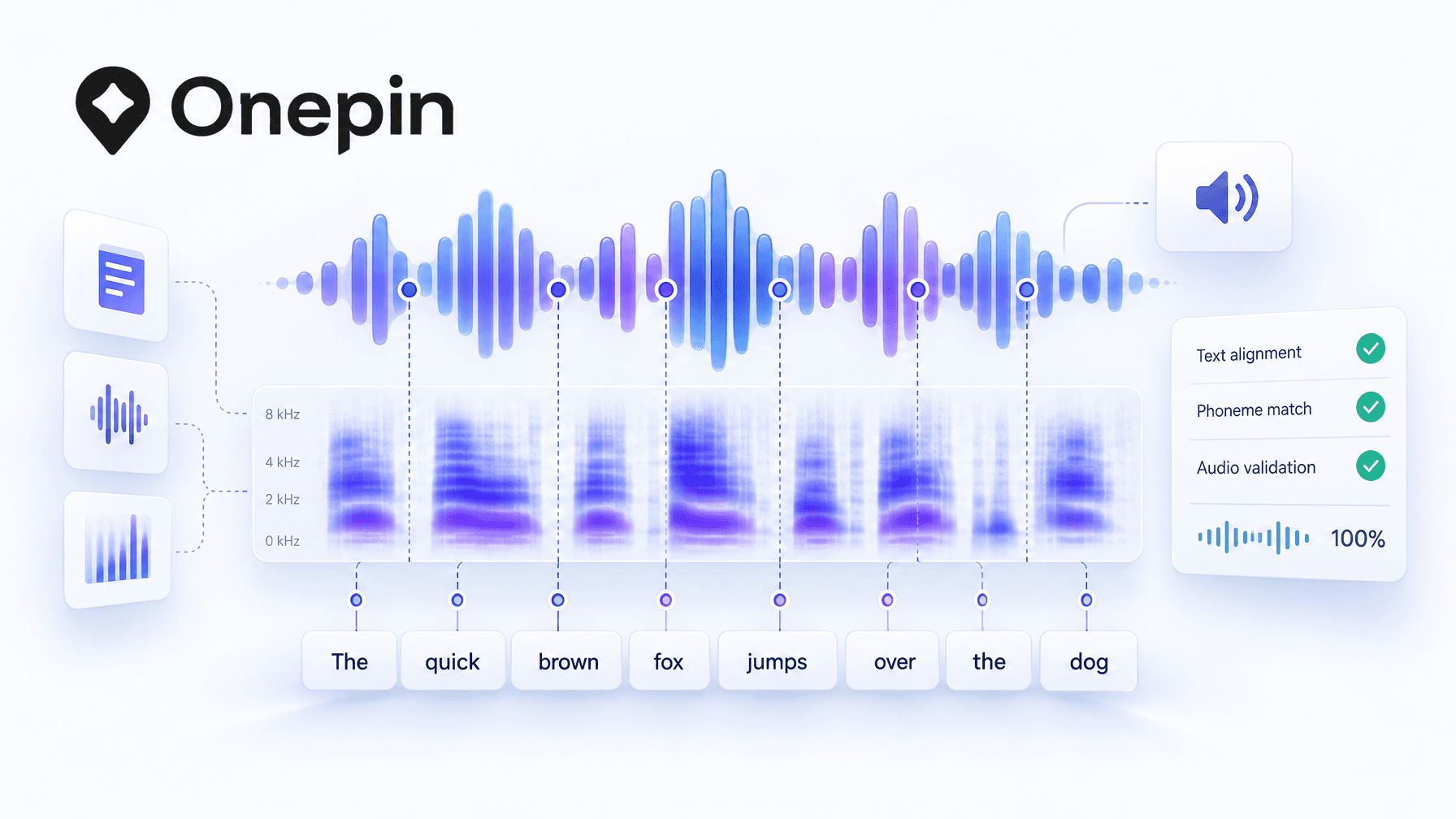
Forced Alignment for TTS: How to Validate AI Voice Audio Before It Ships
Text-to-speech models fail silently. Autoregressive and diffusion voice architectures can drop words, repeat syllables in hallucination loops, or mangle technical terminology while returning a successful HTTP 200 response. Most engineering teams discover these failures only after a customer hears broken audio in production. Standard round-trip speech recognition fails as an automated judge because acoustic decoders paper over subtle pronunciation mistakes with language model priors.
Forced alignment solves this acoustic verification problem by anchoring known script text directly to speech waveforms at millisecond precision. Rather than asking a speech recognition model to guess what was spoken, forced alignment computes the exact temporal boundaries and acoustic probabilities of every expected phoneme.
What is Forced Alignment in Text-to-Speech Validation?
Forced alignment is an acoustic analysis technique that takes an audio recording and its exact reference transcript, then calculates the precise start and end timestamps for every word and individual phoneme in the speech signal.
In traditional speech processing pipelines, forced alignment systems like the Montreal Forced Aligner (MFA) and connectionist temporal classification (CTC) models align training data for speech synthesizers. In a production voice workflow, the role reverses. The engineering team treats the input script as ground truth and runs forced alignment against the generated audio stream to audit the output of the text-to-speech model.
When an engine like ElevenLabs, Deepgram, or Cartesia renders audio, forced alignment answers three critical questions:
- Did the voice engine speak every word in the script?
- Did any words suffer phonetic mutilation, dropped syllables, or unnatural pauses?
- Did the model synthesize unrequested audio artifacts or hallucinated babble at the end of the audio stream?
Research shows that acoustic validation changes automated test fidelity. A study published in the Frontiers in Communication journal on phonetic evaluation engines demonstrated that Word Error Rate (WER) overlooks up to 34% of phonetic pronunciation defects that human listeners rate as unacceptable. Phoneme Error Rate (PER) calculated through forced alignment exposes these issues before audio touches a user.
Why Does Standard ASR Fail at Synthetic Audio QA?
Standard automatic speech recognition (ASR) fails at synthetic voice evaluation because ASR engines compensate for acoustic distortion through probabilistic language models.
When a developer routes synthetic speech through an ASR service like Whisper or Google Cloud Speech-to-Text, the ASR model utilizes its internal language model to predict what the speaker intended to say. If a TTS voice mispronounces "kubernetes" as "koo-ber-net-iss" or drops an unstressed syllable, the ASR language prior auto-corrects the output to the standard dictionary word "Kubernetes." The test suite reports a 0% Word Error Rate, and the engineering pipeline declares the audio flawless, while the customer hears broken pronunciation.
Round-trip ASR validation suffers from three fundamental structural flaws:
- Language Model Hallucination: Generative transcription models hallucinate missing words to make ungrammatical audio sound coherent.
- Bi-directional Error Masking: When an ASR model makes an independent transcription mistake on a correctly pronounced phrase, it triggers a false-positive failure in your CI/CD pipeline.
- Coarse Granularity: Lexical transcription cannot measure phonemic duration, vowel formant placement, or localized acoustic confidence scores.
Forced alignment eliminates linguistic guesswork. Because the alignment algorithm is constrained strictly to the input prompt, it does not speculate about vocabulary. It calculates acoustic alignment scores directly between the raw audio spectrogram and the expected phonetic sequence.
How Does Forced Alignment Detect TTS Failure Modes?
Forced alignment identifies synthetic speech failures by evaluating temporal continuity, phoneme duration metrics, and acoustic posterior probabilities across the entire audio waveform.
1. Word Skipping and Phrase Omission
Neural voice engines occasionally skip entire clauses when encountering non-standard punctuation, emojis, or foreign vocabulary. Forced alignment algorithms identify missing words instantly: the aligner reaches a state where the target token cannot be mapped to any acoustic energy, assigning the word a null duration window or triggering an alignment discontinuity flag.
2. Autoregressive Looping and Phantom Tails
Autoregressive models sometimes enter repetition loops or generate breathy murmurs long after the sentence finishes. Forced alignment tracks the total audio duration against the expected phonetic length. If unaligned speech energy persists past the final aligned token timestamp, the validation layer flags an acoustic boundary violation.
3. Sub-Word Phonetic Corruption
For high-stakes brand names, pharmaceutical terms, and financial tickers, lexical matching is inadequate. Forced alignment breaks words into International Phonetic Alphabet (IPA) tokens using a grapheme-to-phoneme (G2P) engine. If the aligner's acoustic feature encoder (such as a fine-tuned Meta Wav2Vec2 or Google MMS network) fails to match the expected phoneme frame, it triggers an alert on that exact syllable.
What Does an Automated Forced Alignment Pipeline Look Like?
An automated forced alignment validation pipeline consists of four sequential execution stages: text normalization, phonetic expansion, acoustic alignment, and threshold-based policy gating.
Step 1: Text Normalization and Token Expansion
Before audio can be verified, numbers, dates, currency signs, and acronyms must be expanded into their exact spoken representation. A mismatch between "$45" and "forty-five dollars" corrupts alignment before acoustic processing begins.
Step 2: Grapheme-to-Phoneme (G2P) Translation
The normalized text passes through a G2P engine, converting words into canonical phonemic sequences. For custom terms and specialized corporate vocabulary, developers inject a custom pronunciation dictionary or pronunciation lexicon specification (PLS) to establish baseline phonetic expectations.
Step 3: Acoustic Alignment Inference
The generated audio file and the phoneme string enter the alignment model. Using connectionist temporal classification (CTC) forward-backward algorithms or dynamic time warping (DTW), the aligner correlates speech frames (typically 20ms audio windows) with the phonetic sequence.
Step 4: Quality Gate Evaluation
The output contains time-stamped word boundaries and phonetic confidence scores. The validation harness executes automated assertions:
- Completeness Check: All script tokens must map to valid acoustic segments.
- Trailing Audio Check: Unmapped audio after the final token must not exceed ambient noise thresholds (>150ms of unvoiced silence).
- Phonetic Confidence Gate: Average phoneme acoustic score across designated keywords must exceed 0.85.
Architectural Comparison: Validation Approaches for Production Voice
Evaluating voice applications requires balancing latency, accuracy, and operational overhead. The following table contrasts prevailing audio validation methods used across modern voice stacks:
| Metric / Capability | Round-Trip ASR (Whisper/Speechmatics) | LLM-as-a-Judge (Audio Spectrogram) | Forced Alignment (CTC / Wav2Vec2) |
|---|---|---|---|
| Primary Metric | Word Error Rate (WER) | Qualitative Impression / Score | Phoneme Error Rate (PER) + Timestamps |
| Execution Latency | 300ms - 1,200ms | 1,500ms - 4,000ms | 15ms - 50ms |
| Phoneme-Level Accuracy | No (Word level only) | Variable / Hallucination-prone | High (Sub-millisecond resolution) |
| Word Skipping Detection | Poor (Language model fills gap) | Moderate | Deterministic |
| Compute Overhead | Medium | Extreme | Low (Runs on standard CPU/Edge) |
| Language Bias Resistance | Low (Prior alters output) | Low | High (Strictly constrained) |
| Production Feasibility | Async batch only | Expensive offline evals | Real-time & asynchronous |
Data published across speech synthesis benchmarks indicates that forced alignment pipelines execute between 10x and 25x faster than end-to-end ASR transcription while consuming a fraction of inference compute. For real-time conversational agents, sub-50ms execution enables teams to inspect synthesized speech buffers before streaming audio packets across WebSockets.
How Onepin Automates Voice Quality and Acoustic Validation
Connecting individual text-to-speech APIs is straightforward. Ensuring that millions of dynamically generated audio assets pronounce names correctly, preserve cadence, and never drop phrases across different languages is where enterprise engineering teams struggle.
Building proprietary forced alignment harnesses, managing language-specific G2P dictionaries, and tuning acoustic confidence thresholds across hundreds of voice actors creates technical debt.
Onepin is a voice workflow platform that orchestrates, validates, and ships production-ready audio across 100+ TTS models. Instead of treating text-to-speech generation as an unverified one-way API call, Onepin embeds automated validation and quality gates directly into the production loop.
When your applications trigger voice synthesis through Onepin:
- Intelligent Model Selection: Onepin routes requests to the optimal engine for each language, dialect, and latency target.
- Automated Acoustic Validation: Every audio output is validated for completeness, pronunciation accuracy, and format compliance before it ships.
- Automated Recovery and Retry: If an underlying model stumbles, drops words, or introduces phonetic artifacts, Onepin catches the failure and retries or reroutes the generation in milliseconds without human intervention.
Stop shipping unvalidated audio to your users. Explore the Onepin documentation to discover how automated voice orchestration and validation safeguard enterprise voice quality.
Frequently asked questions
- What is forced alignment in text-to-speech validation?
- Forced alignment is an acoustic processing method that maps a known text transcript directly against an audio waveform at the word and phoneme level. In TTS quality assurance, it determines exact start and end timestamps for every syllable and calculates acoustic confidence to verify whether every requested word was correctly vocalized.
- Why is forced alignment better than standard speech-to-text for audio QA?
- Standard speech-to-text models introduce their own language-model bias, substituting phonetically ambiguous or mispronounced words with statistically likely alternatives. Forced alignment eliminates language-model guessing by constraining acoustic matching strictly to the input script, detecting genuine mispronunciations, dropped phrases, and audio hallucinations.
- How does forced alignment catch TTS hallucinations and repetitions?
- Forced alignment tools detect unnatural duration spikes, unmapped acoustic segments, and repeated phonetic sequences that indicate autoregressive model loops. When extra synthetic speech occurs that lacks corresponding tokens in the input prompt, the aligner flags an unmapped boundary error immediately.
- What is the difference between Word Error Rate (WER) and Phoneme Error Rate (PER)?
- Word Error Rate measures full-word lexical matches, overlooking subtle phoneme substitutions, stress misplacements, or slight phonetic distortions that sound wrong to human listeners. Phoneme Error Rate assesses phonetic correctness at the granular acoustic level, providing a rigorous metric for brand names, acronyms, and multilingual pronunciation.
- Can forced alignment run in real time for interactive voice agents?
- Optimized forced alignment pipelines using lightweight acoustic models like CTC-based Wav2Vec2 or MMS run within 15 to 30 milliseconds on audio chunks. This makes acoustic validation practical for real-time turn-taking and conversational voice agents without adding perceptible latency to caller interactions.