Microsoft MAI-Voice-2 Is Impressive. Your Production Stack Still Needs to Be Model-Agnostic.
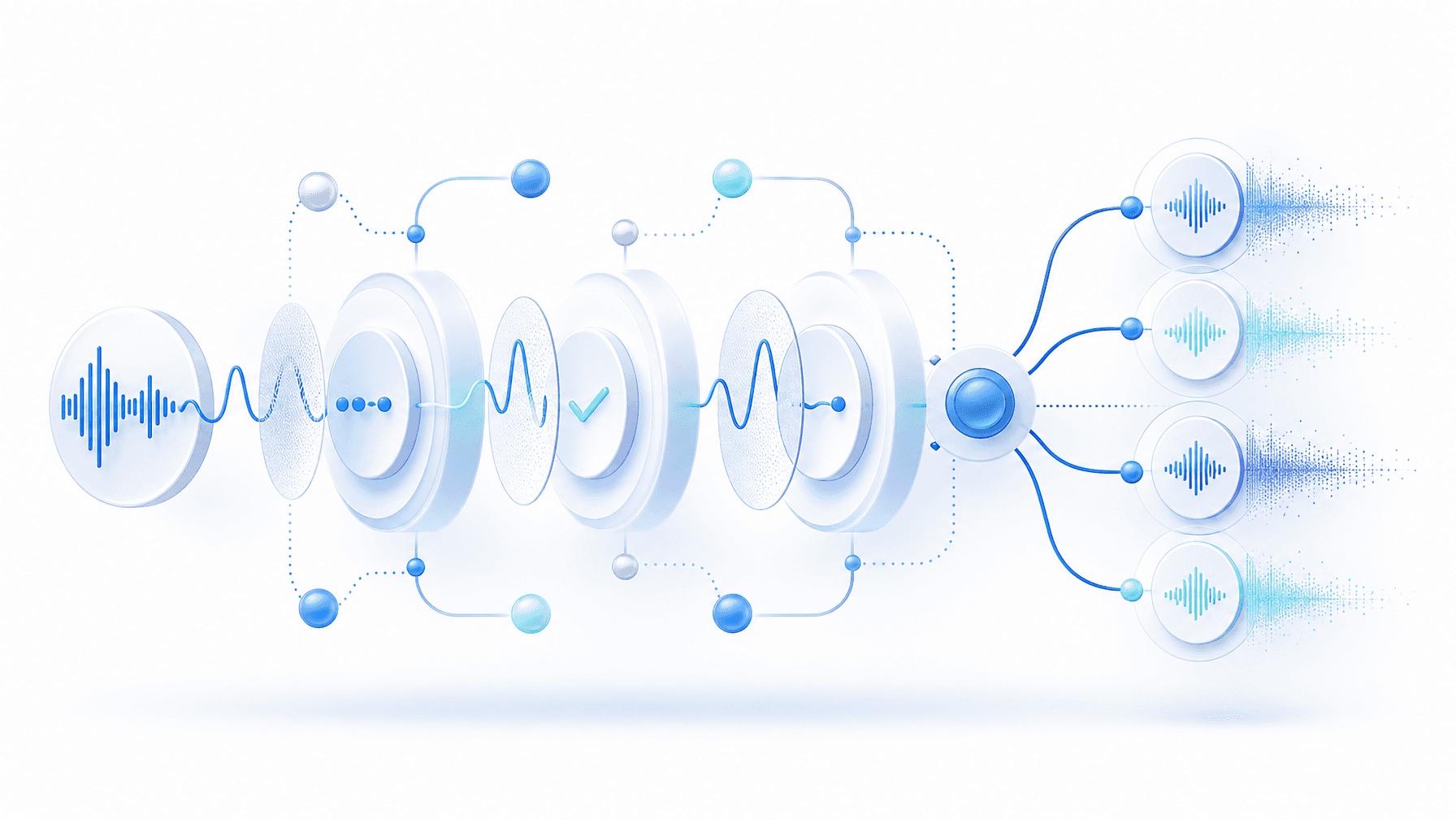
TLDR: Microsoft's MAI-Voice-2 landed June 2, 2026 with 15 languages, granular emotion tags, and a 72% win rate over MAI-Voice-1 in side-by-side tests. Generation quality is real. But the production problem (model version drift, at-scale clip validation, failover routing, and cross-use-case orchestration) is not solved by any single model. Teams that hardcode MAI-Voice-2 will hit the same wall when MAI-Voice-3 ships.
What Microsoft Just Shipped
Microsoft released MAI-Voice-2 on June 2, 2026, and the capabilities are real. In side-by-side preference tests, it beats MAI-Voice-1 72% of the time. Speaker similarity evaluations show generated speech indistinguishable from recordings of the same voice. It supports 15 languages: English (US and AU), French, German, Italian, Hindi, Spanish, Portuguese, Korean, Chinese (Simplified), Turkish, Russian, Thai, Dutch, Romanian, and Hungarian. It handles code-switching natively for Hindi-English and Spanish-English pairs.
The granular emotion tag system (sad, whispered, excited, confused, embarrassed) gives developers control that was absent from MAI-Voice-1. Zero-shot voice prompting works with as little as 5 seconds of reference audio, across all supported languages, with consent guardrails enforced at the system level. Stable speaker identity across long-form content (audiobooks, training modules, lecture series) addresses one of the hardest persistent challenges in production TTS.
MAI-Voice-2 is available in Microsoft Foundry, integrated into VSCode, and shipping inside Dynamics 365 Contact Center. Pricing is $22 per million input tokens via the Foundry API.
Generation Quality vs. Production Quality
MAI-Voice-2 solves the generation problem well. That is what Microsoft's announcement rightly celebrates: getting a single model to produce natural, expressive, multilingual speech is genuinely hard, and MAI-Voice-2 clears the bar.
But production voice AI teams run into a different problem: what happens in the gap between "the model generated audio" and "the audio is validated, shipped, and performing correctly at scale." That gap is where pipelines break.
Four Production Gaps MAI-Voice-2 Doesn't Close
1. Model Version Drift
You validate your voice profiles against MAI-Voice-2. You tune emotion tags, test speaker consistency across 5,000 clips, and sign off on QA. Then Microsoft ships MAI-Voice-3, or a silent patch to MAI-Voice-2. Your validated profiles break. Speaker identity shifts. Brand voice drifts. There is no automatic re-validation, no changelog alert, and no rollback path.
2. Failover Routing
MAI-Voice-2 hits an API latency spike or outage. If you've hardcoded a single provider, the pipeline stalls. There is no automatic fallback to ElevenLabs, Cartesia, or Deepgram Aura-2 while the issue resolves. Single-model means single point of failure.
3. At-Scale Clip Validation
MAI-Voice-2 generates clip 1 beautifully. Does it generate clip 9,847 with the same speaker identity, prosody, and emotional tone? Manual QA doesn't scale. You need automated validation confirming every clip meets the spec, not just that the audio file exists and plays back.
4. Cross-Use-Case Routing
MAI-Voice-2 is optimized for branded assistant voices, audiobooks, and accessibility experiences. A game studio pipeline might need character voices on one model, real-time dialogue on another, and ambient narration on a third. No single model is optimal across every use case in the same application.
Why Model-Agnostic Infrastructure Matters More Now
As generation quality rises across the field, and MAI-Voice-2 is clear evidence it is rising, the meaningful differentiation for production teams shifts to the infrastructure layer. ElevenLabs, Cartesia, Deepgram Aura-2, MAI-Voice-2, Rime AI, and Inworld are all capable. The TTS leaderboard reshuffles every few weeks. Picking one and hardcoding it is a deployment decision, not a production strategy.
Production voice pipelines need:
- A routing layer that selects the right model for each use case: latency-sensitive vs. high-fidelity, branded vs. character
- Automated validation confirming clip quality, speaker similarity, and spec compliance, not just file existence
- Retry logic that re-runs failed or flagged clips, not just reruns the same broken prompt
- An audit trail with model version signatures so you know what shipped when
- Failover routing to an alternate provider when latency or uptime issues arise
Onepin is this layer. It sits above MAI-Voice-2, ElevenLabs, Cartesia, Deepgram, and 100+ other models. It routes, validates, retries, and ships publish-ready audio. When Microsoft ships MAI-Voice-3, Onepin routes to it automatically for use cases where it's the better fit, while keeping other use cases stable on their validated model. No re-engineering required.
When MAI-Voice-2 Is the Right Choice
MAI-Voice-2 is a strong option if you're building inside the Microsoft Foundry or Azure ecosystem and want tight platform integration. If your primary use case falls within its 15 supported languages and you need emotion tag control, zero-shot voice cloning with consent guardrails, or deep integration with Copilot, Dynamics 365, or VSCode, this model delivers.
Avoid locking in exclusively if your pipeline spans multiple use case types, requires more than 15 languages, demands real-time performance across variable quality and latency profiles, or needs model-version audit trails and automated at-scale clip validation.
The Right Frame for MAI-Voice-2
Microsoft built a genuinely capable model. The generation quality is real. The emotion control is real. The multilingual range is real. None of that means the production problem is solved.
What MAI-Voice-2 cannot do is validate its own output at scale, route itself intelligently across use cases, fail over when it struggles, or alert you when a model update breaks your validated voice profiles. That is not a flaw. It is the production layer: the gap between a model that sounds good in a demo and a pipeline that ships 50,000 validated clips to a product.
Ready to run MAI-Voice-2, alongside every other capable model, inside a production-validated pipeline? Explore Onepin.
Frequently asked questions
- What did MAI-Voice-2 launch with?
- MAI-Voice-2 landed June 2, 2026 with 15 languages, granular emotion tags, and a 72% win rate over MAI-Voice-1 in side-by-side tests. It handles code-switching for Hindi-English and Spanish-English, offers zero-shot voice prompting from about 5 seconds of audio, and is priced at $22 per million input tokens via the Foundry API.
- What is model version drift and why does it matter?
- Model version drift is when a provider ships a new version or a silent patch that breaks profiles you already validated. Speaker identity can shift and brand voice can drift with no automatic re-validation, no changelog alert, and no rollback path, so previously signed-off voice profiles fail without warning.
- Why is failover routing necessary for production voice?
- If you hardcode a single provider and it hits a latency spike or outage, the pipeline stalls with no automatic fallback to alternatives like ElevenLabs, Cartesia, or Deepgram Aura-2. A single model means a single point of failure.
- When is MAI-Voice-2 the right choice?
- It is a strong option if you are building inside the Microsoft Foundry or Azure ecosystem and want tight platform integration. It fits when your use case falls within its 15 supported languages and you need emotion tag control, zero-shot voice cloning with consent guardrails, or deep integration with Copilot, Dynamics 365, or VSCode.
- What does Onepin add above MAI-Voice-2?
- Onepin sits above MAI-Voice-2, ElevenLabs, Cartesia, Deepgram, and 100+ other models, handling routing, automated clip validation, retries, an audit trail with model version signatures, and failover. When Microsoft ships a newer model, Onepin routes to it for the right use cases while keeping others stable, with no re-engineering.