OmniOps and Hamsa Call It Production-Ready. Here's What That Claim Is Missing.
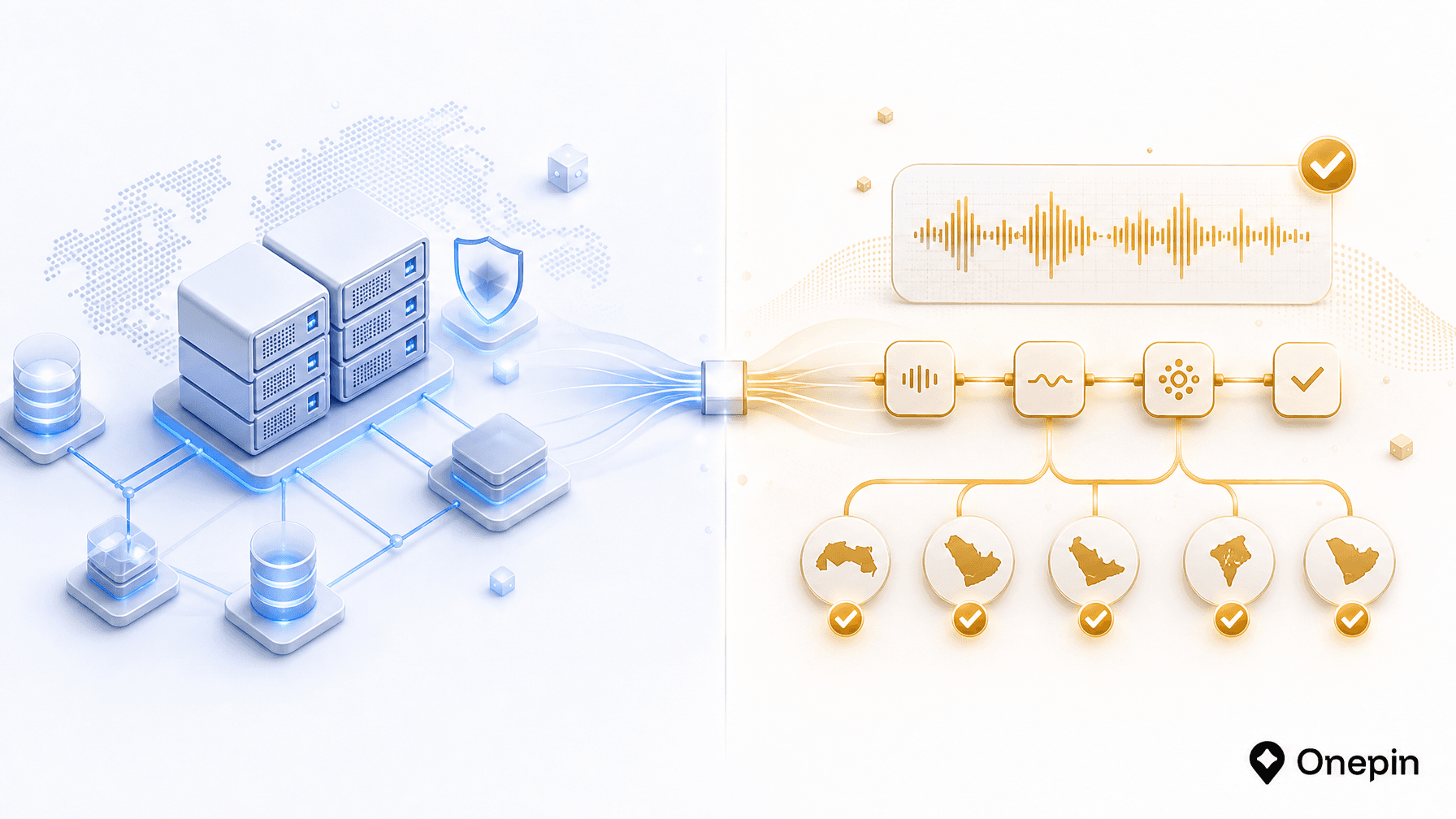
Production-ready Arabic voice AI means every output passes quality validation across all target dialects and use cases before any customer hears it. Sovereign infrastructure solves where voice data lives and is processed. It does not validate whether the audio output is accurate. For enterprises deploying Arabic voice AI at scale, these are two separate problems, and solving one does not automatically solve the other.
On July 15, 2026, OmniOps and Hamsa announced a partnership to bring "production-ready" Arabic voice AI to Saudi Arabia. The deal combines Hamsa's Arabic Speech-to-Text, Text-to-Speech, and AI agent technologies with Bunyan, OmniOps' sovereign inference platform, keeping inference and data processing inside the Kingdom. The companies target enterprise contact centers, voice authentication systems, and AI agents conducting phone conversations in Arabic and English.
The infrastructure story is sound. Keeping voice data inside Saudi borders addresses the Kingdom's Personal Data Protection Law, reduces exposure for organizations handling sensitive customer interactions, and gives enterprises a local partner for high-performance computing and deployment. Those are legitimate problems worth solving.
But the partnership's "production-ready" framing treats two different problems as one. Sovereign infrastructure tells you where data lives. It does not tell you whether the voice output is correct.
What Does "Production-Ready" Actually Require for Arabic Voice AI?
Production-ready Arabic voice AI requires validated output quality, not just validated infrastructure. Hamsa covers more than a dozen regional Arabic varieties in its TTS system: Saudi, Emirati, Bahraini, Qatari, Kuwaiti, Omani, Palestinian, Jordanian, Lebanese, Syrian, Egyptian, Levantine, and Iraqi dialects, plus Modern Standard Arabic and English. Each dialect is a separate quality surface. A pronunciation that passes Gulf Arabic validation may fail in Levantine. A voice profile trained on Modern Standard Arabic may drift when the input shifts to colloquial Saudi.
This is not a criticism of the underlying technology. Building Arabic-first voice models is genuinely difficult work that most Western AI labs have skipped. The Gulf dialect coverage, Arabic diacritical mark support, and multi-dialect TTS represent real progress on a problem most providers ignore.
The gap is not the technology. The gap is that the announcement says nothing about how organizations verify output quality across those dialect surfaces before audio ships to a customer.
How Does Code-Switching Multiply the Quality Surface?
Code-switching between Arabic and English is standard practice in Saudi enterprise environments, and Hamsa explicitly supports it. Speakers shift languages mid-sentence within the same conversation, and that capability introduces a new quality surface that compounds the per-dialect problem.
Every Arabic-English transition is a point where pronunciation, prosody, and acoustic character can degrade. A model that handles Gulf Arabic correctly and handles English correctly may still mispronounce English loanwords in an Arabic context, drop the correct prosodic transition, or produce acoustic artifacts at the language boundary. No sovereign infrastructure announcement addresses how those degradation events get detected before audio reaches a customer.
The Unite.AI article covering the partnership makes this explicit: "success will depend on how consistently the technology performs across Saudi dialects, noisy telephone connections, mixed-language conversations and specialized terminology." That sentence describes a production validation problem. The Bunyan platform does not solve it.
Why Do "Production-Ready" Claims Keep Skipping Output Validation?
This pattern runs through every major voice AI partnership and product launch in 2026. "Production-ready" consistently means the system generates audio reliably, connects to CRM software, and runs on compliant infrastructure. It rarely means every output has been quality-scored, every dialect combination has been tested, and model updates are locked so validated voice profiles cannot silently break.
The structural reason is simple: infrastructure is visible, output quality is not. A sovereign platform has an architecture diagram. A pronunciation error has no dashboard entry until a customer reports it.
For Arabic enterprise voice, the stakes are higher than they appear in a partnership announcement. Mispronunciation of an account number in a banking IVR call is not just a quality defect. It is a trust failure in a language where enterprise AI has historically underserved speakers. A contact center deploying voice AI without per-dialect quality scoring has no mechanism to separate accurate calls from quietly wrong ones.
Saudi Arabia's Personal Data Protection Law addresses where data is processed. It does not address whether the audio output of that processing is accurate. Both require deliberate infrastructure. Only one came with this announcement.
How Do You Close the Production Gap in Multilingual Voice AI?
Closing the production gap in multilingual voice AI requires a validation layer above the TTS model, not inside the infrastructure platform. Onepin is a voice workflow platform that orchestrates, validates, and ships production-ready audio across 100+ TTS models. It sits between the TTS model and the delivery channel, running quality scoring, pronunciation validation, model version locking, and format compliance checks on every output before it ships.
For Arabic voice AI deployments, a production validation layer needs four things:
Per-dialect validation baselines. Each regional Arabic variety requires a separate quality threshold and a stored set of reference clips. A passing score for Egyptian Arabic does not predict Gulf Arabic accuracy. Per-dialect baselines catch dialect-specific failures that aggregate scores miss.
Code-switching transition scoring. Every Arabic-English language switch within a clip is a potential quality drop. Automated scoring at the transition point, not just across the full clip, surfaces the failure mode before it reaches the delivery channel.
Model version locking. Sovereign infrastructure keeps inference inside Saudi Arabia. It does not prevent the TTS provider from updating their model and silently breaking validated voice profiles. Version locking ties each deployed voice to the exact model version it was tested against and flags any drift.
Per-output audit trail. Regulatory conversations in Saudi Arabia will eventually reach AI voice output quality, not just data residency. A per-output audit trail (quality score, model version, dialect, timestamp) makes that conversation manageable.
OmniOps and Hamsa are building the infrastructure side of Arabic enterprise voice. That work is necessary. But infrastructure without output validation ships audio that is sovereign in location and unverified in quality.
If you are deploying voice AI across Arabic dialects or any multilingual environment, Onepin adds the validation and orchestration layer that infrastructure platforms do not include. Learn more at onepin.ai.