OpenAI Adds SynthID Voice Watermarks One Day Before EU AI Act Enforcement. Provenance Is Not Validation.
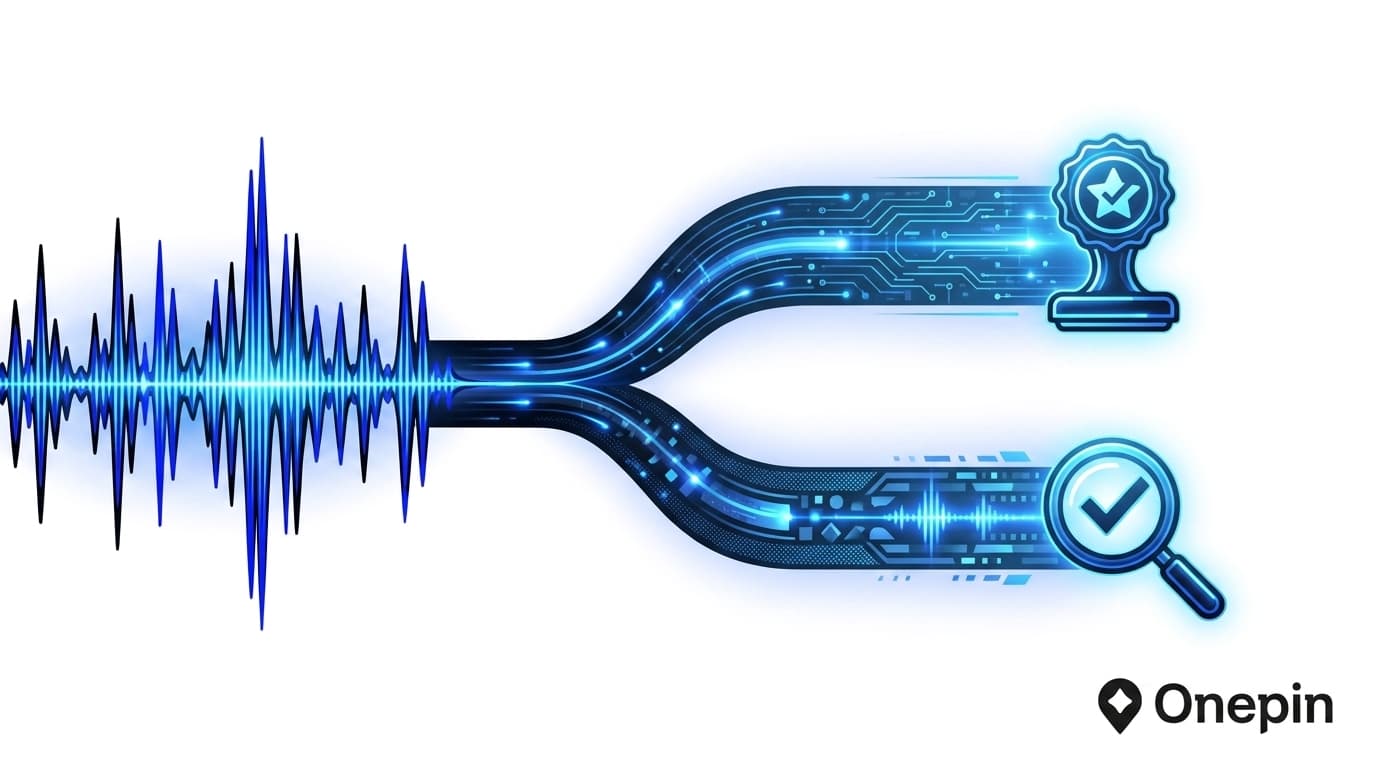
OpenAI updated GPT-Live on July 31, 2026, to embed Google DeepMind's SynthID watermarking into all audio generated through ChatGPT Voice and the OpenAI API. The update also opened a developer verification API that lets any organization check whether a given audio file carries an OpenAI-origin provenance signal.
The timing is not subtle. EU AI Act Article 50 transparency obligations take effect on August 2, 2026, across all 27 member states. Non-compliance can attract fines of up to 15 million euros or 3% of worldwide annual turnover. OpenAI shipped the watermark with one day to spare.
This is a significant infrastructure move. It is also exactly half the problem.
What Does SynthID Audio Watermarking Actually Do?
SynthID embeds an inaudible signal into the spectrogram of AI-generated audio using psychoacoustic masking. The watermark survives MP3 compression, speed and pitch shifts, and even the analog hole (playing audio through a speaker and re-recording it through a microphone). A metadata tag would not survive any of those transformations. The embedded signal does.
The developer verification API is the meaningful addition. Previously, provenance checking for AI-generated voice required uploading to a user-facing tool. Now any developer can build provenance checks directly into an automated pipeline: newsroom review, platform content moderation, enterprise compliance.
The scope at launch is limited to OpenAI-origin audio. Audio from ElevenLabs, Cartesia, open-source voice cloning tools, or any other provider returns no signal. The absence of a detected watermark does not mean the audio is authentic. It means only that OpenAI's GPT-Live system did not produce it.
Why Provenance Is Not the Same as Validation
Watermarking answers a single question: was this audio generated by AI?
It does not answer: did this audio pronounce the brand name correctly? Did it say the right dollar amount? Did the voice stay consistent across a 10,000-clip library? Does the audio meet the telephony format spec for the target deployment channel?
These are different questions with different failure modes. A watermarked audio clip that carries perfect provenance can still mispronounce a customer's name, drift from the locked voice profile by clip 200, or ship in a format that fails silently on a G.711 telephony channel. The provenance is intact. The output is wrong.
Article 50 requires proving origin. Production requires proving correctness. The EU mandates the first. Nobody mandates the second. That is the gap.
What the Industry Gets Wrong About Compliance
The rush to comply with Article 50 reveals a pattern: teams treat regulatory compliance as the quality standard. If the watermark is embedded and the disclosure is present, the obligation is met and the audio ships.
But Article 50 is a transparency requirement, not a quality requirement. It certifies that the audio is AI-generated. It says nothing about whether the AI-generated audio is good. A perfectly compliant clip can still carry a mispronounced medication name in a healthcare IVR, a wrong account number in a banking notification, or a drifted narrator voice in an audiobook chapter.
The practical result is that compliance infrastructure and production infrastructure develop on separate tracks. Watermarking gets resourced because the regulatory deadline is fixed and the fine is concrete. Output validation gets deferred because there is no regulatory penalty for shipping a clip that mispronounces "Worcestershire."
The penalty for that comes from customers, not regulators. It arrives as a support ticket, a brand complaint, or a silent churn event that nobody traces back to the audio.
How a Production Layer Closes the Gap
Provenance and validation are two layers that sit above the generation model. Watermarking handles provenance. A production layer handles validation.
Onepin is a voice workflow platform that orchestrates, validates, and ships production-ready audio across 100+ TTS models. For every output, it runs the audio against a locked reference to score pronunciation accuracy, voice consistency, and format compliance. Outputs that fail get regenerated automatically. Outputs that pass ship with a quality score attached.
The distinction matters at scale. A single clip can be spot-checked by a human. Ten thousand clips cannot. A watermarked clip with no quality score is a compliant mystery: you know who made it but not whether it is right. A validated clip with a quality score is a production asset: you know it meets the standard before it reaches a listener.
Watermarking proves origin. Validation proves correctness. The EU now requires the first. Production has always required both.
What This Means for Voice AI Teams
If you generate synthetic audio that reaches the EU market, the Article 50 clock is now running. OpenAI's SynthID integration covers GPT-Live output. Teams using other providers need to verify their own watermarking compliance independently.
But compliance is the floor, not the ceiling. The harder question is not "can we prove this audio is AI-generated?" It is "can we prove this audio is correct before it ships?"
The answer requires a production layer above the model: locked voice profiles, pronunciation validation against reference, model version locking, format compliance checks, and per-output quality scoring. Watermarking does not provide any of these. It was never designed to.
The regulatory infrastructure for provenance now exists. The production infrastructure for validation is still something each team builds or buys on its own. That is where the actual quality risk lives.
Frequently asked questions
- What is SynthID audio watermarking on GPT-Live?
- SynthID is Google DeepMind's watermarking technology that embeds an inaudible signal into the spectrogram of AI-generated audio. OpenAI integrated it into GPT-Live on July 31, 2026, so all voice output from ChatGPT Voice and the OpenAI API now carries a machine-readable provenance marker. A new developer verification API lets any organization check whether a given audio file was generated by GPT-Live.
- Does watermarking validate the quality of AI voice output?
- No. Watermarking answers one question: was this audio generated by AI? It does not check whether the audio pronounced names correctly, said the right numbers, maintained voice consistency, or met format requirements. Provenance and output validation are two separate layers, and watermarking only covers the first.
- What does EU AI Act Article 50 require for synthetic audio?
- Article 50 requires providers of generative AI systems to embed machine-readable markers in synthetic audio so it can be detected as artificially generated. Enforcement begins August 2, 2026, with fines up to 15 million euros or 3% of global turnover. A grace period extends to December 2, 2026, for systems already on the EU market before August 2.
- How does Onepin handle the validation gap that watermarking does not cover?
- Onepin is a voice workflow platform that orchestrates, validates, and ships production-ready audio across 100+ TTS models. It scores every output against a locked reference for pronunciation accuracy, voice consistency, and format compliance before the audio ships. Watermarking proves origin. Onepin proves correctness.