WebRTC vs SIP for AI Voice Agents: Latency, Codecs, and Telephony Architecture
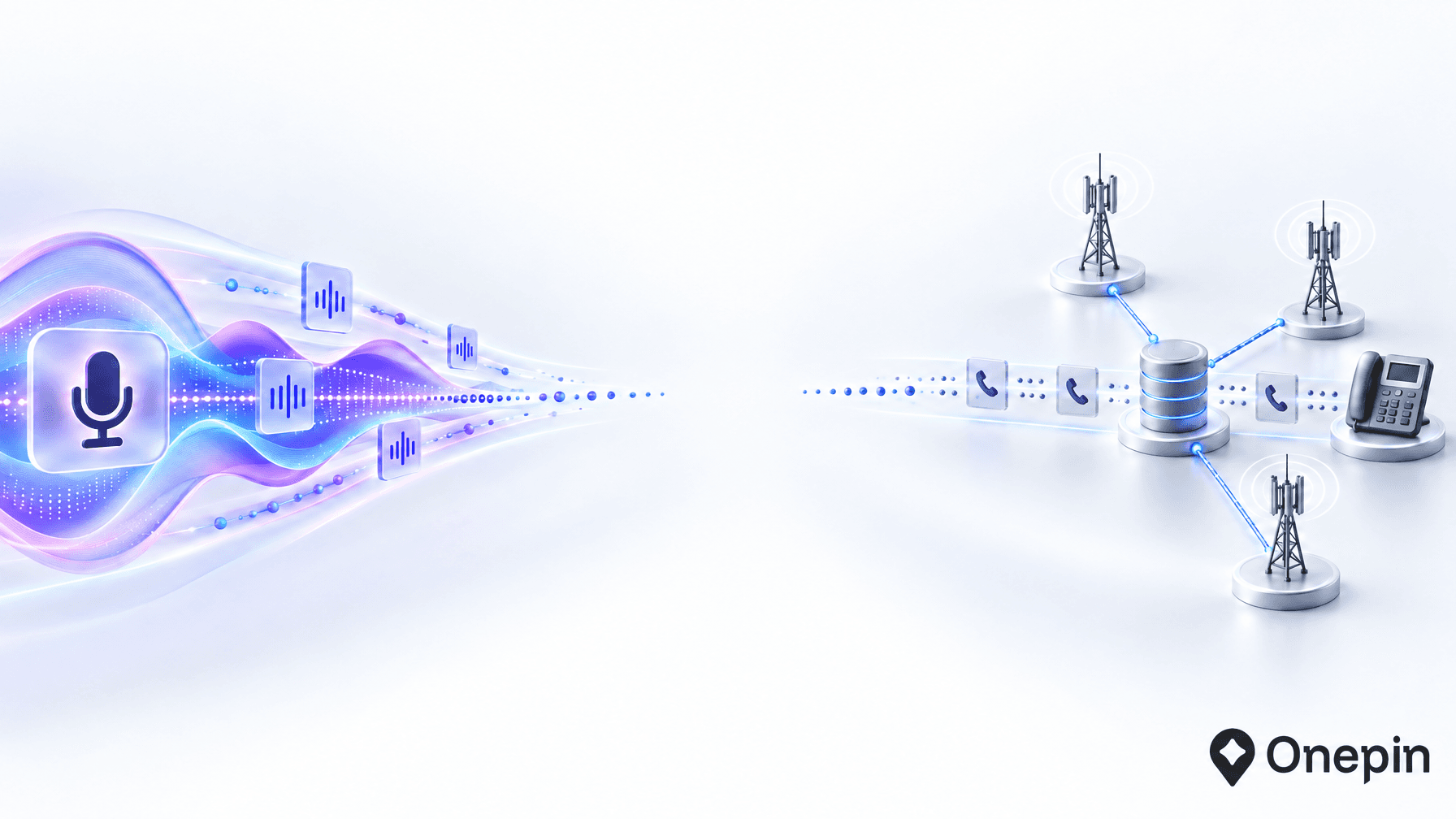
TLDR: The choice between WebRTC and SIP for AI voice agents dictates how your application manages latency, audio fidelity, and carrier connectivity. WebRTC runs over UDP with native Opus codec support, delivering sub-50ms transport latency and 48kHz wideband audio ideal for browser and mobile voice interfaces. SIP connects directly to global PSTN telephony networks and contact centers using G.711 or G.729 codecs, introducing 150ms to 300ms carrier hop latency while ensuring phone number accessibility. This guide compares transport latency, codec trade-offs, barge-in interruption mechanics, and multi-model TTS orchestration across 100+ models.
Real-time audio transport governs how speech packets travel between a human speaker, cloud intelligence models, and client audio devices. In conversational AI systems, audio transport defines your available latency budget, speech recognition accuracy, and voice naturalness. Interactive voice agents succeed when end-to-end response times remain under human conversational thresholds, while transport packet drops and carrier transcoding introduce cognitive dissonance.
Engineering teams scaling voice AI bots quickly realize that model selection across providers like Cartesia, ElevenLabs, and Deepgram represents only one portion of the conversational loop. If your transport protocol introduces 250 milliseconds of carrier jitter, even the fastest streaming text-to-speech model cannot preserve a natural conversational cadence. Choosing between WebRTC (Web Real-Time Communication) and SIP (Session Initiation Protocol) determines whether your voice agent communicates with wideband fidelity or legacy telephony constraints.
What is the difference between WebRTC and SIP in conversational AI pipelines?
WebRTC and SIP solve different communication challenges within the voice architecture stack. WebRTC provides an end-to-end framework for direct, encrypted peer-to-peer media streaming over UDP, incorporating built-in jitter buffers, echo cancellation, and the high-fidelity Opus audio codec. SIP is an application-layer signaling protocol designed to establish, maintain, and terminate multimedia communication sessions across enterprise PBX hardware, VoIP carriers, and the global Public Switched Telephone Network (PSTN).
| Architectural Feature | WebRTC (Web Real-Time Communication) | SIP (Session Initiation Protocol) |
|---|---|---|
| Primary Media Transport | SRTP over UDP (Direct media plane) | RTP over UDP / TCP / TLS (via SBC proxies) |
| Transport Latency | Sub-50ms (typical 20ms to 45ms) | 150ms to 300ms (PSTN carrier routing hops) |
| Native Audio Codec | Opus (6kHz to 48kHz dynamic wideband) | G.711 (8kHz narrowband mu-law/A-law), G.729 |
| Client Environment | Web browsers, mobile SDKs, Electron, smart hardware | Inbound/outbound phone numbers, SIP trunks, PBX |
| Interruption / Barge-in | Sub-20ms packet drop via data channel signal | 80ms to 180ms signaling lag through telephony trunk |
| Primary Production Fit | In-app assistants, browser agents, gaming NPC voice | Call center automation, outbound dispatch, inbound IVR |
In a conversational voice agent pipeline, incoming user speech passes through three sequential computational phases: Automatic Speech Recognition (STT), Large Language Model generation (LLM), and Text-to-Speech synthesis (TTS). This pipeline operates within an unyielding round-trip conversational window. Research by telephone engineering pioneers at Bell Labs demonstrated that humans perceive conversational lag whenever interactive turn-taking delays exceed 300 milliseconds. When transport latency consumes 200ms of that budget before processing begins, downstream models run out of time to compute responses.
How does transport latency impact conversational voice agent responsiveness?
Transport latency dictates how many milliseconds remain for speech recognition, LLM reasoning, and neural voice synthesis. In a WebRTC architecture, client audio streams directly to an edge media server via selective forwarding units (SFU) like LiveKit or Daily. Media packets reach the ingestion gateway within 20ms to 45ms over broadband and 5G connections. This minimal transport footprint leaves 250ms of your conversational budget available for streaming transcription, first-token LLM generation, and streaming TTS synthesis.
In a SIP telephony architecture, audio travels through telecommunication carrier hops, local exchange carriers, and Session Border Controllers before arriving at cloud infrastructure. A phone call initiated from a cellular carrier traverses radio access networks and PSTN gateways, adding 150ms to 250ms of network transit time. If your streaming TTS engine delivers a Time to First Audio (TTFA) of 120ms and your LLM streams its first token in 100ms, the SIP transport overhead pushes total turn-taking latency past 450ms. Users experience noticeable awkward silence before the agent begins speaking.
To prevent perceptual conversational stalls over SIP, engineering teams often employ aggressive speculative execution and filler phrases. WebRTC pipelines bypass these masking tactics because raw transport speed allows immediate synthesis directly from first LLM tokens.
Which audio codecs preserve neural TTS quality across WebRTC and SIP?
Audio codec selection governs the acoustic bandwidth, dynamic range, and vocal warmth delivered to your user. Modern generative neural TTS models synthesize high-fidelity audio at 24kHz, 44.1kHz, or 48kHz sample rates. These models generate intricate vocal nuances, breath sounds, and emotional inflections that convey authentic human presence.
WebRTC mandates native support for the Opus audio codec (RFC 6716). Opus dynamically scales bitrates from 6 kbps to 510 kbps and supports full-band 48kHz audio sampling. When a voice agent synthesizes audio through engines like ElevenLabs or Cartesia at 24kHz PCM, WebRTC transports the complete audio spectrum without downsampling. Sibilants, consonant clarity, and low-frequency vocal resonances remain crisp and intelligible.
Traditional SIP trunks across the PSTN rely on legacy codecs engineered for copper telephone wires:
- G.711 (Pulse Code Modulation): Operating at 64 kbps, G.711 samples audio at 8kHz with 8-bit resolution, capping audible frequencies at 3.4kHz. Passing a premium 48kHz neural voice through a G.711 trunk truncates vocal overtones, introducing characteristic tinny telephone bandpass distortion.
- G.729 (CS-ACELP): Designed to compress voice over constrained bandwidth at 8 kbps, G.729 strips subtle acoustic variations. Neural speech passed through G.729 codecs introduces robotic compression artifacts and degraded consonant intelligibility.
- AMR-WB and G.722 (HD Voice): When enterprise SIP carriers support wideband HD Voice, sampling rates increase to 16kHz with frequency responses up to 7kHz. While significantly clearer than G.711, HD Voice still discards frequencies above 7kHz that high-end AI voice models produce.
Downsampling high-resolution audio to 8kHz also degrades speech-to-text accuracy on incoming user audio. Inbound 8kHz G.711 telephone audio increases Word Error Rates (WER) in transcription engines by 12% to 18% compared to clean 48kHz Opus streams, compounding conversational misunderstandings in noisy environments.
How do WebRTC and SIP handle real-time barge-in and interruptions?
Barge-in allows a human speaker to interrupt an AI agent mid-sentence, mirroring natural human conversational etiquette. Implementing clean, low-latency interruptions requires synchronous two-way communication between speech detection, media playback buffers, and the generation pipeline.
In a WebRTC architecture, the client application monitors local microphone input through client-side Voice Activity Detection (VAD). The moment speech energy exceeds threshold levels:
- The client dispatches a lightweight binary cancel command over a WebRTC Data Channel directly to the agent worker.
- The agent server instantly stops LLM token generation and signals the TTS engine to terminate synthesis.
- The local WebRTC audio track clears its playback jitter buffer within 15 milliseconds, immediately silencing the synthetic voice before the user finishes their first interrupting syllable.
Handling interruptions over SIP is far more difficult due to transmission latency and carrier-level audio buffering. Because traditional telephone handsets do not run custom client software, interruption detection must occur on the remote server via server-side VAD. By the time the user's voice packets navigate cellular towers, PSTN switches, and SIP gateway buffers to reach the server VAD, the user has been speaking for 120ms to 200ms. Furthermore, audio already queued inside the telephony provider's outbound RTP buffer continues playing into the caller's ear, making the agent feel clumsy and slow.
When should enterprise architectures deploy WebRTC versus SIP?
The choice between WebRTC and SIP depends on user access channels, existing infrastructure integrations, and deployment environments. High-performing enterprise voice architectures avoid treating this as a binary decision; they implement hybrid architectures that route each interaction through its optimal transport protocol.
Deploy WebRTC for:
- In-App Mobile and Web Voice Assistants: WebRTC operates natively inside all major web browsers (Chrome, Safari, Firefox, Edge) without plugins or third-party telephony accounts.
- Smart Hardware and IoT Devices: Connected appliances, in-car infotainment systems, and robotics hardware stream clean Opus audio directly over Wi-Fi or 5G data links.
- High-Fidelity Concierge Experiences: Luxury hospitality, language learning apps, and therapeutic voice agents where emotional nuance, wideband sound, and sub-200ms conversational turn-taking are core product requirements.
Deploy SIP for:
- Inbound Customer Support Telephony: Callers dialing published 1-800 telephone numbers or international DID numbers must enter through PSTN telecom carriers.
- Enterprise Contact Center Integrations: Integrating with existing contact center infrastructure like Twilio, Genesys Cloud, Five9, or Cisco CUCM requires standards-compliant SIP trunking and RTP media streams.
- Outbound Automated Telephony Dispatch: Scheduling reminders, emergency notifications, and verification callbacks routed to standard mobile phones rely on global carrier termination.
How does Onepin orchestrate multi-model TTS across WebRTC and SIP pipelines?
Onepin is a voice workflow platform that orchestrates, validates, and ships production-ready audio across 100+ TTS models. Connecting conversational AI pipelines to both WebRTC media clusters and legacy telephony SIP trunks exposes engineering teams to complex format mismatches, varying vendor latency profiles, and unpredictable pronunciation failures.
When an AI voice agent operates over SIP, high-sample-rate audio streams must be dynamically downsampled to 8kHz mu-law without clipping or phase distortion. Conversely, when streaming over WebRTC, the system must deliver full-bandwidth Opus frames while enforcing sub-150ms TTFA across underlying synthesis providers.
Onepin abstracts these infrastructure burdens into an intelligent orchestration layer. Applications push text tokens once, and Onepin handles provider routing, real-time audio chunking, automated codec translation, and carrier-specific loudness normalization. Built-in pronunciation validation checks ensure that brand names, numerical expressions, and technical terms sound flawless regardless of whether audio streams to an iPhone browser via WebRTC or an office landline over a SIP trunk.
Discover how to streamline your enterprise voice pipeline and eliminate single-provider vulnerabilities by exploring the documentation at onepin.ai/docs.
Frequently asked questions
- What is the primary difference between WebRTC and SIP for AI voice agents?
- WebRTC is a peer-to-peer real-time media transport optimized for web browsers and mobile apps using the Opus codec over UDP with sub-50ms transport latency. SIP is a signaling protocol used to establish, route, and terminate telephone calls across public switched telephone networks (PSTN) and enterprise PBX systems, typically operating over narrowband codecs like G.711.
- Why is WebRTC faster than SIP for voice AI applications?
- WebRTC streams audio frames directly over encrypted UDP via SRTP, eliminating intermediate telecommunication switching centers and session border controller queues. SIP calls must traverse telephony carriers, cellular base stations, and PSTN gateways, adding 150ms to 300ms of carrier-level delay before reaching your agent pipeline.
- Can an AI voice agent support both WebRTC and SIP simultaneously?
- Yes. Production architectures frequently run dual ingest: a WebRTC gateway using media servers like LiveKit or Daily for web and in-app users, and a SIP trunk through providers like Twilio or Telnyx for inbound telephone calls. Both transports feed into a unified speech-to-text, LLM, and TTS orchestration pipeline.
- How does audio codec selection affect TTS output quality across WebRTC and SIP?
- WebRTC supports full-band 48kHz Opus audio, preserving the natural tone, warmth, and emotion generated by modern neural TTS models. Traditional SIP calls downsample synthesized audio to 8kHz narrowband G.711 mu-law, stripping frequencies above 3.4kHz and flattening emotional inflections.
- How does Onepin orchestrate TTS models across WebRTC and SIP audio pipelines?
- Onepin is a voice workflow platform that orchestrates, validates, and ships production-ready audio across 100+ TTS models. It automatically handles audio resampling, dynamic format conversions, and latency-optimized routing so voice agents deliver pristine audio whether streaming over WebRTC data channels or legacy telephony SIP trunks.