Low Latency TTS API: Sub-200ms Voice Agent Options
TLDR
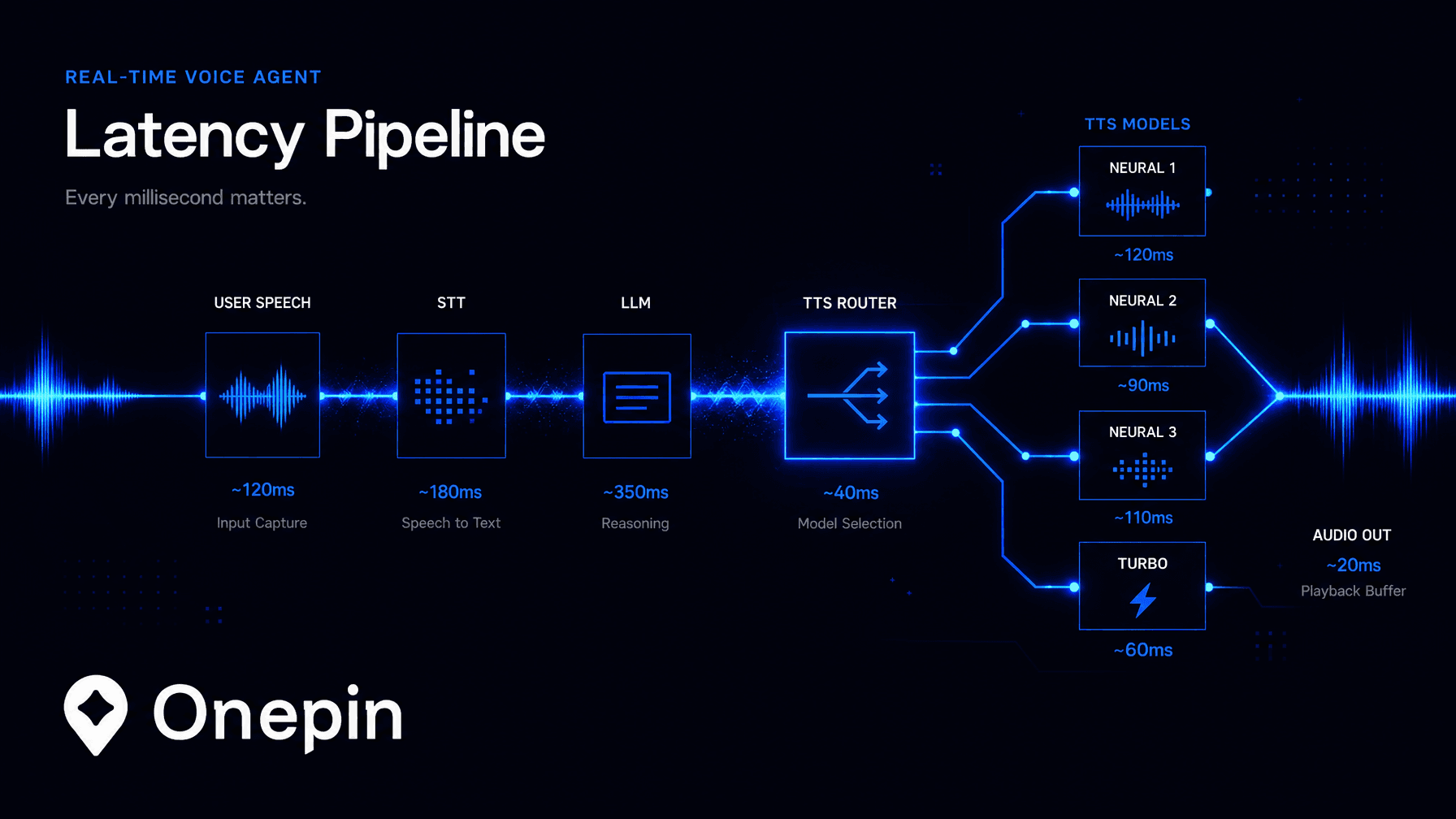
The best TTS API for a real-time voice agent is the one that hits sub-200ms time-to-first-audio (TTFA) without failing on pronunciation, drift, or format. Cartesia Sonic 3.5 leads on raw speed (~40ms TTFA). ElevenLabs Flash v2.5 leads on quality and language coverage. Deepgram Aura-2 leads on unified STT + TTS for call centers. Most teams need more than one, and Onepin routes each turn to the right model with validation built in. For the full production stack around agents, see the voice AI platform production guide.
What Makes a TTS API Good for Voice Agents?
A TTS API is good for voice agents when it returns the first audio chunk fast enough to feel conversational and streams the rest without gaps. Everything else is secondary to that single constraint. Research on turn-taking shows users perceive a pause above roughly 200ms as an awkward silence, so TTFA under 200ms is the hard requirement for live agents.
Five factors separate a voice-agent TTS API from a general one:
- Latency (TTFA): The delay to the first audio chunk. This is the number that decides whether a conversation feels natural.
- Streaming support: The API must stream audio as it renders, not wait for the full clip. Non-streaming APIs are unusable for live turns.
- STT and turn-detection integration: Tight coupling with speech-to-text and end-of-turn signals removes cross-provider handoff overhead.
- Language coverage: A multilingual agent needs consistent quality across every locale it serves, not just English.
- Cost per minute: Voice agents run continuously, so per-minute price compounds fast at scale.
How Do I Score a TTS API for a Voice Agent?
Score each candidate on the six dimensions that predict production behavior, then weight TTFA and streaming highest for live use. The table below rates the leading APIs on a voice-agent scorecard.
| API | TTFA (P50) | Streaming | STT Integration | Languages | Pricing | Reliability |
|---|---|---|---|---|---|---|
| Cartesia Sonic 3.5 | ~40ms | Yes | Ink-2 STT | English-first | Usage-based | High |
| Deepgram Aura-2 | ~150ms | Yes | Unified STT + TTS | English-primary | ~$4.50/hr agent | High |
| ElevenLabs Flash v2.5 | ~264ms | Yes | Third-party STT | 70+ | Credit-based | High |
| Google Gemini 3.1 Flash TTS | Variable | Yes | Google STT | Broad | Token-based | Medium-High |
| xAI Grok Voice | ~sub-second | Yes | Bundled | Growing | $0.05/min | Medium |
Which TTS APIs Are Best for Voice Agents in 2026?
The best TTS APIs for voice agents in 2026 are Cartesia, Deepgram, ElevenLabs, Google, and xAI, each optimized for a different constraint. Here is how they compare on the dimensions that matter for real-time agents.
1. Cartesia Sonic 3.5. Fastest TTFA
Cartesia is the speed specialist. Its state space model architecture delivers roughly 40ms time-to-first-audio, among the lowest measured for any cloud TTS API, and its Ink-2 STT integration keeps the full round trip tight. It is English-first, which makes it the default pick for latency-critical, English-language phone and voice-assistant turns. When the constraint is raw speed, Cartesia is hard to beat.
2. Deepgram Aura-2. Unified Stack for Call Centers
Deepgram bundles STT, TTS, and a Voice Agent API under one integration. Aura-2 runs near 150ms TTFA and shares a single API key with Nova transcription, which removes cross-provider handoff overhead and simplifies billing. For contact-center and call-center workloads where the whole pipeline lives with one vendor, Deepgram is the operationally simplest choice.
3. ElevenLabs Flash v2.5. Quality and Language Coverage
ElevenLabs Flash v2.5 trades a little speed for the broadest reach. At roughly 264ms TTFA it is slower than Cartesia, but it covers 70+ languages and leads on naturalness and expressiveness. For quality-sensitive brand voices and multilingual agents, ElevenLabs remains the reference point even when its latency sits above the 200ms conversational line.
4. Google Gemini 3.1 Flash TTS. Broad Coverage
Google Gemini 3.1 Flash TTS brings wide language coverage and deep integration with Google's STT and cloud stack. Latency is variable and depends on region and configuration, so it needs measurement against real traffic before a live deployment. It suits teams already committed to Google Cloud that want multilingual reach without adding a new vendor.
5. xAI Grok Voice. Aggressive Pricing
xAI Grok Voice collapses the stack into a single speech-to-speech model priced at $0.05 per minute, undercutting most competitors. The cost is attractive, but a single bundled model concentrates risk: one point of failure with no independent validation or fallback path. It is a strong prototype option where budget leads and a fallback layer sits above it.
What Is the Latency-Quality Tradeoff?
The latency-quality tradeoff is the reality that no single TTS model is both the fastest and the highest fidelity. Cartesia wins on speed at ~40ms TTFA but is English-first. ElevenLabs wins on quality and 70+ languages but sits near 264ms. A team that commits to one model accepts a permanent compromise on the other axis.
That compromise is fine for a single-use-case agent. It breaks down the moment one agent serves both a latency-sensitive English phone flow and a quality-sensitive Spanish brand interaction. The two paths have opposite optimal models, and one model cannot satisfy both.
The Production Question Nobody Asks
Sub-200ms TTFA gets audio to the user fast, but speed is only one dimension of a shippable output. The question that decides production reliability is whether the audio passes quality validation once it arrives. Latency answers how fast; it says nothing about whether the pronunciation is correct, whether the voice drifted across a long session, or whether the format matches the telephony channel.
A voice agent that responds in 40ms and mispronounces the caller's account number is still a failed interaction. Consistent pronunciation of domain terms, zero drift across turns, and format compliance (codec, sample rate, loudness) are separate requirements that no latency benchmark measures. Teams that optimize TTFA alone ship fast audio that still fails on the outputs that matter.
How Does Multi-Model Routing Solve This?
Multi-model routing solves the tradeoff by sending each turn to the model that fits it, rather than forcing one model to serve every turn. Latency-sensitive paths route to Cartesia, quality-sensitive or multilingual paths route to ElevenLabs or Gemini, and a validation step checks every output regardless of which model ran.
Onepin is a voice workflow platform that orchestrates, validates, and ships production-ready audio across 100+ TTS models. For voice agents, it routes each call path to the right model, Cartesia for speed, ElevenLabs or Gemini for quality and language, then validates pronunciation, drift, and format on every output before it reaches the caller. When a faster or better model ships next quarter, the change is a routing config update, not a rewrite. That approach turns the latency-quality tradeoff from a permanent architecture decision into a per-turn routing rule.
For deeper comparisons, see our ElevenLabs vs Cartesia breakdown, the Deepgram Aura-2 vs Cartesia Sonic voice-agent comparison, the Deepgram vs Cartesia TTS API comparison, the 2026 TTS models benchmark guide, the voice AI platform production guide, and our explainer on what TTS orchestration is.
Final Take
Cartesia is the fastest, ElevenLabs is the highest quality and most multilingual, and Deepgram is the simplest unified stack. There is no universal best TTS API for voice agents, only the best model for each turn. Score your candidates on TTFA, streaming, integration, languages, price, and reliability, then build a stack that routes and validates rather than locks you to one permanent compromise.
Frequently asked questions
- What is the lowest latency TTS API in 2026?
- Cartesia Sonic 3.5 is the lowest latency TTS API in 2026, with time-to-first-audio near 40ms on its state space model architecture. Deepgram Aura-2 follows at roughly 150ms, and ElevenLabs Flash v2.5 lands around 264ms. Latency figures vary by region, payload, and concurrency, so measure against your own traffic before committing.
- Which TTS API is best for real-time voice agents?
- There is no single winner, because voice agents balance three needs: speed, quality, and language coverage. Cartesia is best for latency-sensitive English turns, ElevenLabs is best for quality-sensitive or multilingual turns, and Deepgram is strong for unified call-center stacks. Many production teams route different turns to different models rather than pick one permanently.
- What does TTFA mean in TTS?
- TTFA means time-to-first-audio, the delay between sending text to a TTS API and hearing the first audio chunk. For live voice agents it matters more than total render time, because streaming playback starts on the first chunk. Users notice conversational pauses above roughly 200ms, so TTFA is the primary latency metric for real-time agents.
- How do I choose a TTS API for a voice agent?
- Score each API on TTFA, streaming support, STT integration, language coverage, price per minute, and reliability. Weight TTFA and streaming highest for live agents, then confirm the audio passes quality validation for pronunciation, drift, and format. Choosing on a demo clip alone hides the failures that only appear at production volume.
- Should I use one TTS model or route across several?
- Routing across several models is the production answer for most serious voice agent teams. A single model forces a permanent trade between speed and quality, while routing sends latency-sensitive turns to a fast model and quality-sensitive turns to a higher-fidelity one. An orchestration layer makes that routing a config change rather than a rewrite.