Best Voice AI Platform in 2026: Model API vs Production Layer
Description
The best voice AI platform in 2026 is the production layer that routes, validates, and ships audio across many TTS models. This guide shows how that differs from a single engine API, which metrics to trust, and when Onepin fits.
Best Voice AI Platform in 2026: Model API vs Production Layer
#TLDR
A voice AI platform is the production layer above text-to-speech models. The best one plans jobs, routes them across engines, validates pronunciation and format, retries failures, and ships publish-ready audio. Teams that stop at a single TTS API generate clips. They do not run a production pipeline.
What is the best voice AI platform in 2026?
The best voice AI platform in 2026 is the layer that treats speech as a job, not a one-shot API call. It takes a script, a voice profile, a locale, and delivery rules, then runs generate, check, retry, and ship until the file meets those rules.
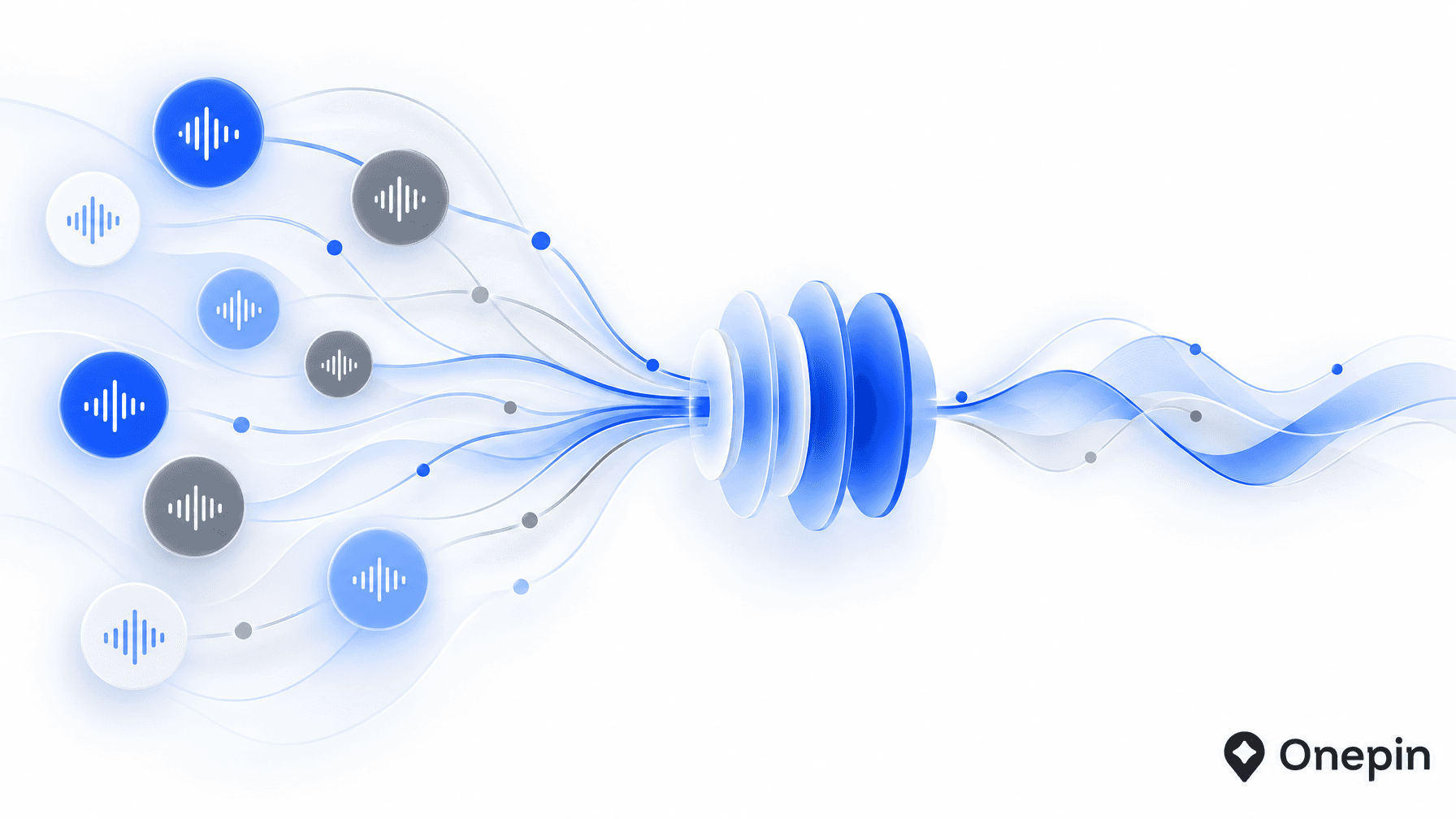
Onepin is a voice workflow platform that orchestrates, validates, and ships production-ready audio across 100+ TTS models. Engines such as ElevenLabs, Deepgram Aura, Cartesia Sonic, and Google Cloud Text-to-Speech stay engines.
Gartner predicts 40% of enterprise applications will include task-specific AI agents by the end of 2026, up from less than 5% in 2025. Many of those agents speak. The bottleneck is not another model. It is the layer that decides which model to call and whether the audio is allowed to leave the building.
What is the difference between a TTS API and a voice AI platform?
A TTS API converts text to audio. A voice AI platform treats that conversion as one step in a pipeline you can audit.
Inworld splits the market into three tiers: model-only APIs (ElevenLabs, Cartesia, Deepgram), framework orchestrators (LiveKit, Pipecat), and full-stack infrastructure. A production voice AI platform for output sits above model-only APIs. It does not replace STT or the LLM. It owns how speech is produced and whether it is fit to publish.
| Layer | TTS API | Voice AI platform |
|---|---|---|
| Job | One request, one file | Plan, generate, check, retry, ship |
| Models | One vendor | Many engines, routed per job |
| Quality gate | HTTP 200 | Pronunciation and format checks |
| Failure | You debug the file | Automatic retry or fallback |
| Lock-in | High | Swap engines without rewriting the app |
Princeton researchers showed that adding citations, quotations, and statistics can boost visibility in generative engines by up to 40%. The same rule applies to your own stack: named checks beat demo clips.
How do I compare voice AI platforms without trusting a demo?
You compare voice AI platforms on your glossary, your load, and your file specs, not on a homepage sample.
Coval's 2026 comparison names five metrics for live agents: latency, transcription accuracy (WER), task completion, cost per conversation, and reliability. Excellent TTFB is under 300ms. Users treat delays over 500ms as unnatural and delays over 2 seconds as a hang-up. Those numbers are for conversational agents. Batch voiceover has a different clock, but the same rule: a green HTTP status is not a ship decision.
Coval also flags the trap: vendors self-report favorable metrics, and demo rooms hide background noise, accents, and concurrent load. Independent arenas such as the Artificial Analysis Speech Arena are useful for ranking native voices. They do not tell you whether your SKU is pronounced correctly.
1. Glossary tests, not arena scores. Build a 30-line script from real product names, competitors, and legal lines. Generate it on two or three models. Pass/fail is pronunciation of those names.
2. Per-language routing. A vendor language list is coverage. Quality still varies. The platform should pick a different engine for JA than for ES if your tests say so.
3. Retry and fallback. If a line fails loudness, duration, or a pronunciation check, regenerate on the same model or switch engines without a human export loop.
4. Format control. Sample rate, container, and integrated loudness must match the player (LMS, IVR, YouTube, in-app).
5. Model independence. If the vendor you like ships a worse checkpoint next quarter, you change a route. You do not rewrite the product.
For the model map, see the TTS leaderboard guide. For the category definition, see what TTS orchestration is.
What does pricing look like when you pick one engine?
Pricing looks simple on a vendor page and messy once you add retries, locales, and failed generations.
ElevenLabs bills shared credits: Free at $0 (10k credits), Starter $6 (30k), Creator $22 (121k), Pro $99 (600k), Scale $299 (1.8M credits, 3 seats), Business $990 (6M credits, 10 seats). For V2 Multilingual, 1 character equals 1 credit. Flash/Turbo API usage can cost 0.5 to 1 credit per character.
Deepgram is pay-as-you-go with $200 free credit. Aura-2 TTS is $0.030 per 1k characters on Pay As You Go ($0.027 on Growth). Flux TTS is $0.045 per 1k ($0.0405 on Growth). Voice Agent API Standard is $0.075 per minute of websocket time.
Those numbers buy generation. They do not buy a second model when Spanish fails, a glossary gate, or a consistent loudness target. Credits spent on regenerations you still reject are a hidden line item.
Why does using Onepin mean you are not locked into one model?
Using Onepin means the app talks to a production layer, not a single vendor SDK. Onepin is a voice workflow platform that orchestrates, validates, and ships production-ready audio across 100+ TTS models. You keep ElevenLabs for expressive English, Deepgram for a streaming agent, Google for a locale catalog, and you change routes when a checkpoint drifts.
The job is the product:
- Scripts and glossary live next to the CMS or repo.
- Surface (course, IVR, YouTube, in-product coach) sets latency, expressiveness, and file rules.
- Generate on the routed model. Lock voice ID and model version.
- Validate pronunciation, duration, and format. ASR word error is the wrong metric for TTS.
- Retry or fall back.
- Ship versioned files. Yesterday's clip does not mix with today's product name.
That loop is what "best voice AI platform" should mean in 2026.
Start with the job, not the vendor
Pick the surfaces you ship this quarter. Write the glossary. Run three models against it. Then put a voice AI platform above the winner so a silent model update cannot rewrite every file you published last week.
Try Onepin if you already have ElevenLabs, Deepgram, Cartesia, or Google and still spend cycles re-exporting audio after every product rename.
Frequently asked questions
- What is the best voice AI platform in 2026?
- The best voice AI platform is the production layer above text-to-speech APIs. It routes jobs across engines, checks pronunciation and format, retries failures, and ships files your LMS, CMS, or app can use. A single TTS vendor can generate well and still fail as a platform.
- What is the difference between a TTS API and a voice AI platform?
- A TTS API turns text into audio. A voice AI platform treats that API as one engine among many. It owns routing, validation, fallbacks, and delivery so a model update or a bad locale does not silently ship broken clips.
- How should I compare voice AI platforms?
- Score pronunciation on your real product names, not a public leaderboard. Check per-language routing, retry and fallback, format control, and whether you can swap models without rewriting the pipeline. Latency and WER matter for live agents; batch voiceover needs glossary accuracy and file specs.
- Do I need a voice AI platform if I already use ElevenLabs or Deepgram?
- You still need one if you ship more than a demo. Those APIs generate well. They do not score your glossary, retry a failed locale on a different engine, or keep sample rate and loudness consistent across every file you publish.