Do TTS Platforms Charge You for Failed Generations? Yes, and What to Do About It
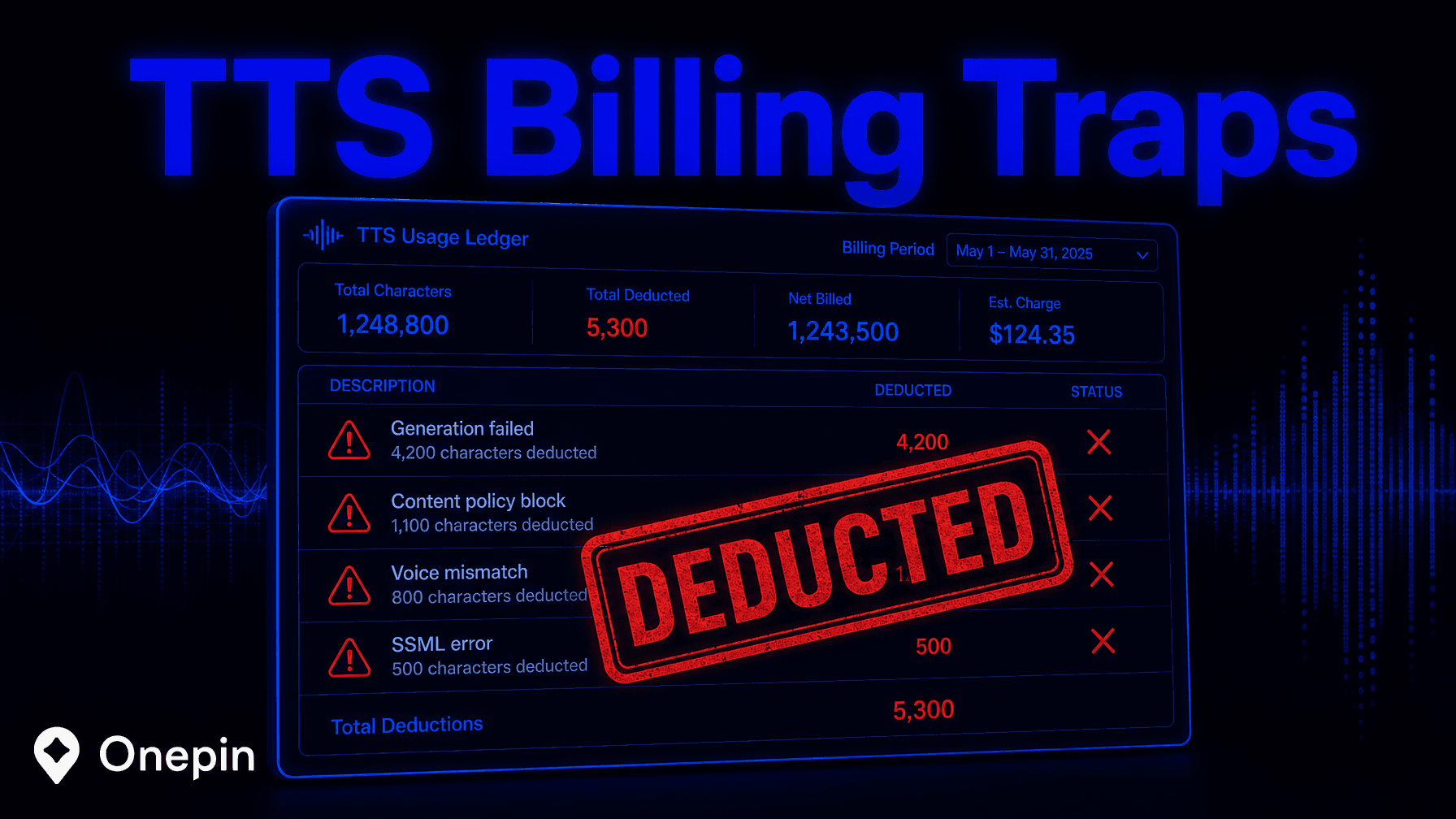
TTS billing charges for failed generations are a documented, unresolved problem across major voice platforms. Most platforms deduct credits based on characters submitted, not on whether the output audio is usable. A timeout, content policy block, or server-side error still consumes your budget. Combined with credit expiry on cancel and the compounding cost of retakes at scale, the real TTS bill is often two to three times what teams estimate before production begins.
What counts as a "failed" TTS generation?
A failed TTS generation is any request where the API accepts input but does not return production-ready audio. Four failure modes appear regularly in production pipelines.
Timeout. The request processes beyond the platform's time limit and returns an error. Characters are already submitted. Most platforms count the request against your quota.
Content policy block. The submitted text violates the platform's content guidelines. The request is rejected post-submission. Credits are generally consumed because the API processed the input before the block triggered.
Server-side API error. A 500-level error occurs during generation. Whether credits are deducted depends on where in the pipeline the error occurred. Platforms rarely document this scenario explicitly in their public documentation.
Low-quality output. The generation completes and returns audio, but the output has mispronunciations, artifacts, or acoustic drift that make it unusable. This is the most expensive failure mode. It costs credits and requires a retake. No refund mechanism exists for quality failures. The platform succeeded technically, even when the output is not usable.
The fourth type is what G2 business reviewers call "charged for the model's own mistakes." Among G2 buyers of TTS tools, this billing pattern generates more anger than pricing itself. Users can accept expensive. Adversarial billing, paying for audio that was never usable, is a different experience.
Do major TTS platforms charge for failed generations?
Here is what can be verified from public documentation and user reports as of July 2026.
ElevenLabs charges character credits based on characters submitted to the API. Their documentation does not offer automatic refunds for failed or low-quality generations. Subscription plan credits expire at the end of each billing cycle with no rollover. Multiple user reports confirm unused credits disappear on the renewal date, and there is no automatic credit recovery for server-side failures. Enterprise customers have a billing contact, but standard plan holders have limited recourse.
Deepgram uses pay-as-you-go pricing per character with no subscription credit pool to expire. Because billing is per request on successful delivery, the credit expiry trap does not apply. However, automated retry loops at high volume can generate runaway charges if not capped. Pay-as-you-go requires monitoring at scale.
Cartesia operates a credit-based model. Credit rollover and expiry terms on cancellation are not prominently documented in public pricing pages. Verify directly before purchasing.
Murf and WellSaid Labs both use subscription-based credit plans. WellSaid targets enterprise teams with seat-based pricing, which reduces per-generation credit exposure but does not eliminate retake costs for large content libraries.
A consistent pattern: most platforms do not publish explicit policies on what happens to credits when a generation fails. The absence of a stated refund policy is itself a risk signal. Request written confirmation before you sign a contract.
The credit expiry trap: what happens when you cancel?
The credit expiry problem compounds the failure charge problem. Standard subscription plans on most TTS platforms reset monthly. Unused credits are forfeited at the cycle end. When you cancel a subscription mid-cycle, remaining credits disappear immediately on most platforms.
The consequence hits teams that purchase a higher-tier plan to cover a production push (a batch of 5,000 clips for a new product launch) and finish early. Downgrading or canceling after the batch forfeits remaining credits. At $0.30 per 1,000 characters, a 100,000-character overage represents $30 in direct loss. At enterprise volume, that number compounds across multiple projects.
The pattern appears consistently in user reports: "You lose every unused credit the moment you cancel." The practical workaround: align plan renewals around production timelines, not calendar months. Buy credits close to when you plan to use them.
The retake economics problem: why 2% failure rate matters at scale
A 2% per-generation failure rate sounds low. At production volume, it is not. On 10,000 audio clips, a 2% failure rate produces 200 clips requiring retakes. At $0.30 per 1,000 characters and an average clip of 500 characters, those 200 retakes cost $30 in additional credits, before accounting for the engineering time to detect, log, and re-queue failures.
At 100,000 clips, a 2% failure rate produces 2,000 retakes and the unbudgeted cost grows linearly with scale. Teams that test with 100 hand-picked scripts and observe zero failures are not measuring the production failure rate. They are measuring the best-case sample. Production exposes the tail.
The retake problem connects directly to the retry loop problem. An automated pipeline that retries failed generations without a cap can consume 10 to 20 times the expected credits before anyone notices. This is the mechanism behind the "$1,089 charged out of nowhere" complaint patterns that appear on forums covering large-scale TTS usage: not fraud, but retry loops without budget guardrails.
See the TTS API pricing guide for a full breakdown of per-character and subscription billing models across providers.
What to demand from any TTS provider before you buy
Three requirements protect your budget at production scale. Verify each before committing.
Pre-generation cost estimate. The API should return a character count and estimated credit cost before generation runs. Opaque per-character pricing where you discover the bill only after the run is a risk at scale. Some enterprise plans include pre-flight cost APIs. Ask if yours does.
No charge for server-side failures. A provider whose infrastructure causes a failure should not deduct credits for that failure. Test this in a free-tier run, or request written confirmation of the policy for your contract tier.
Credit rollover on downgrade or cancel. If you paid for credits, you should be able to use them. Verify whether rollover applies on plan changes and cancellation, not just on month-to-month renewals.
If you are evaluating a switch, the guide to switching TTS providers covers how to migrate credit-based workflows without losing validated output.
How to protect your TTS budget at scale
Five practices reduce billing exposure regardless of which platform you use.
Run small test batches before scaling. Generate 100 clips from actual production content, not a curated test set, before committing to a large batch. This surfaces the real failure rate before it scales.
Audit credit consumption weekly. Compare credits consumed to audio files successfully delivered. A ratio consistently above 1.0 means failed generations are going undetected and accumulating cost.
Set retry limits in your pipeline. Unbounded retries are the primary driver of runaway credit charges. Cap retries at three per clip. Escalate anything beyond that to human review.
Read the refund policy before you buy. Most TTS platforms do not advertise refund policies prominently. Find the credit forfeiture clause in the terms of service, not the pricing page, before purchasing.
Lock budget by batch, not by month. Allocate credits to specific production batches rather than purchasing large blocks in advance. This limits exposure when production timelines shift.
How Onepin changes the retake economics
Onepin is a voice workflow platform that orchestrates, validates, and ships production-ready audio across 100+ TTS models. Onepin's retry logic operates above the TTS model layer: failed generations are detected automatically, re-queued on an alternative model, and resolved before they reach your output queue. You pay for audio that passes quality validation, not for credits the model consumed on failures.
For teams running large generation batches, this means the retake economics problem resolves at the pipeline level rather than surfacing in your billing statement. Learn more about what TTS orchestration means in practice and how Onepin sits above any single provider to prevent failed generation costs from reaching your budget.