Why AI Voice Drifts in Long Audio, and How to Keep It Consistent
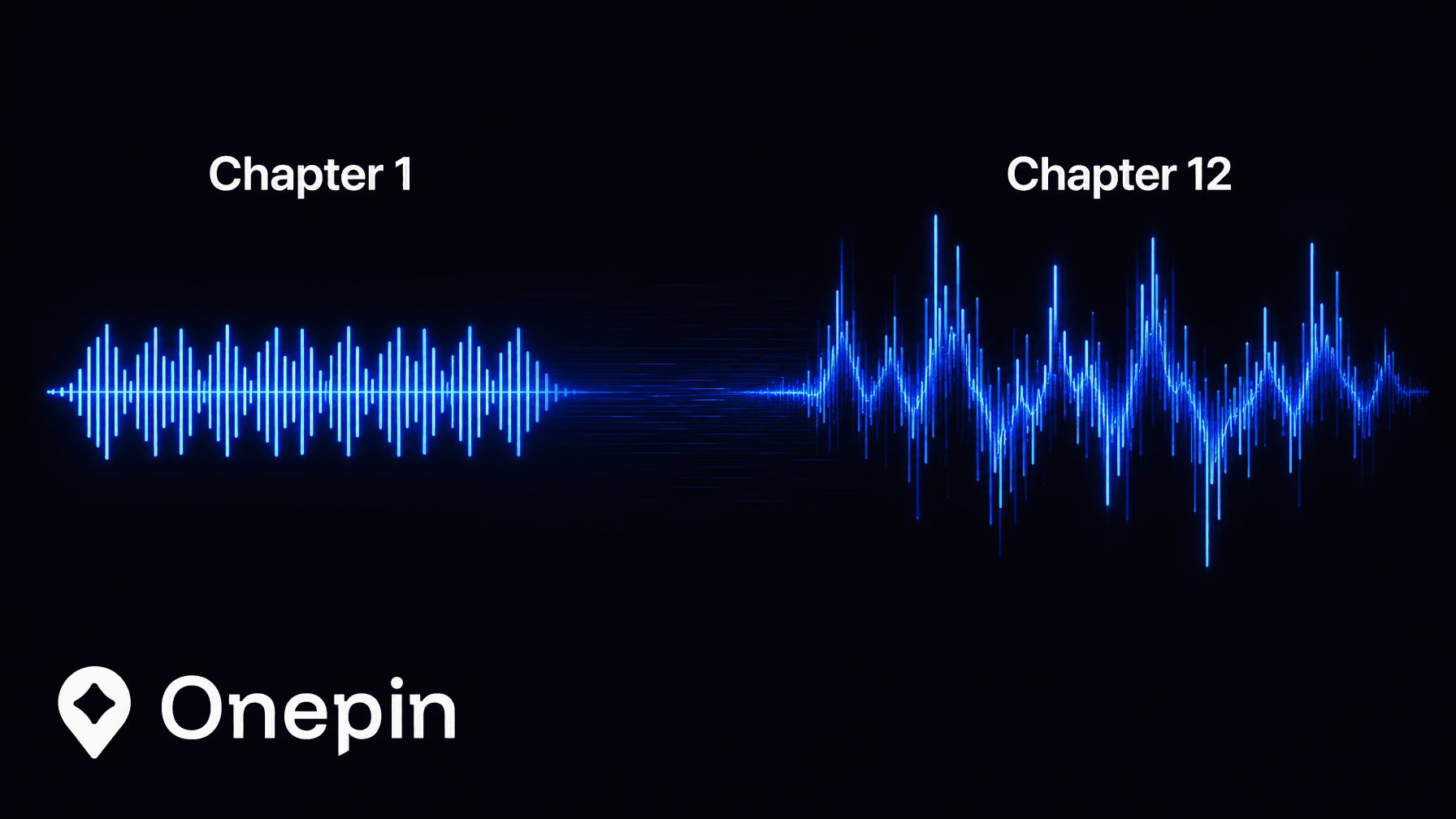
TTS voice drift is the gradual shift in pacing, pitch, stress patterns, and energy level that accumulates across a long-form audio generation run. The core cause is not a broken model. It is the inherent stochasticity of probabilistic TTS generation combined with the structural limits of API-based pipelines. A listener cannot always name the problem, but they notice it: the narrator sounds measured and confident in chapter 1 and subtly rushed or flatter by chapter 12. Listener retention data shows this. Audio editor logs confirm it. Teams producing long-form narration encounter it every production cycle.
What is voice drift in text to speech?
Voice drift is not a single sudden change. It is the slow accumulation of micro-variations in acoustic output across a long generation run. A single chapter of an audiobook involves 50 to 100 separate API calls. Each generation is statistically independent. Even when the voice ID, temperature, and prompt structure are identical across calls, the distribution of pitch, energy, and speaking rate varies slightly per sample. Across 50 samples, those micro-variations compound. The result is a narrator who sounds confident in chapter 1 and subtly lower in energy, narrower in pitch range, or faster in pacing by chapter 12.
Audio editors flag this as inconsistency in the mix. Listeners describe it as the narrator "switching registers" or sounding "tired." The model has not changed. The output distribution has drifted.
Why does AI voice sound inconsistent in long audio?
Three structural causes produce voice drift in long-form TTS pipelines.
Context window limits. Every TTS API processes a segment in isolation. Longer generation attempts (feeding 10,000 words in a single call) hit context limits and produce segmented output anyway, often with a quality drop at the chunk boundary. The model has no memory of how it rendered chapter 3 when it renders chapter 7. No standard TTS API carries stylistic context forward between sessions.
Model stochasticity. TTS generation is probabilistic, not deterministic. The same input text, same voice ID, and same API parameters produce acoustically different output on each run. Stability and similarity controls in platforms like ElevenLabs or Cartesia narrow the variance but do not eliminate it. A stability setting of 0.8 still allows meaningful variation in pitch contour and speaking rate across a 100-call batch.
API session boundaries. Each new API call starts fresh. There is no session state that carries voice tone or energy level from one call to the next. A production pipeline that generates chapters in separate overnight runs (common when multiple editors work on a project) introduces a third variance source: parameters may differ slightly between runs, the model may have received a silent update, or infrastructure conditions affect generation timing.
These three causes act independently and stack. A 12-chapter audiobook with 80 API calls per chapter has 960 statistically independent generation events. Cumulative drift across those 960 events produces an output that listeners hear as inconsistent, even though every individual call looked correct.
What teams do today, and why it fails
Two workarounds appear in production forums covering audiobook TTS workflows.
The first is a single long generation run. Feeding the entire script to one API call attempts to "let the model be consistent with itself." This approach hits context limits above 10,000 to 15,000 words and produces degraded output at chunk boundaries. The model does not maintain style coherence across a chunked input any better than it does across separate calls.
The second is manual stitching. Teams generate chapters separately and rely on an audio editor to normalize the output in post-production. This works at small scale. At 12 chapters and 8 hours of audio, the editor flags 40 to 60 inconsistent segments per pass. Without a reference baseline, "inside tolerance" is a judgment call, not a measurement. The final output adds human variance on top of model variance.
Neither approach measures drift. Both treat consistency as a post-generation problem. Drift detection has to happen at generation time, before bad segments accumulate.
Three signals appear before listener complaints surface. Audio editors flag segments where the narrator "sounds tired" or "loses authority" in the second half of a project, not a recording problem, since there is no human recording. Listener reviews on audiobook platforms use phrases like "the narrator seemed to speed up in later chapters": pacing drift in the probability distribution of inter-word timing. And a team that regenerates a chapter three months after initial production finds it sounds noticeably different from the original, because the provider pushed a silent model update between runs.
If your team currently spot-checks 10 to 20 segments per chapter rather than scoring every segment, you measure drift on a sample too small to detect compound accumulation.
How do I keep AI voice consistent across chapters?
Four techniques close the drift gap. Apply them at generation time, not in post-production.
1. Voice profile locking. Capture every relevant voice parameter (voice ID, stability, similarity boost, style settings, generation temperature) as a fixed config file stored in version control alongside the script. Apply the identical config to every segment. This eliminates inter-run parameter variance. When a provider updates their model and the config produces different output, the discrepancy surfaces immediately rather than shipping undetected.
2. Reference clip anchoring. Generate a 30-second reference clip at the start of production under the locked profile. Score every subsequent segment against that reference using cosine similarity on the acoustic embedding. A similarity score below 0.85 flags the segment for regeneration before it enters the assembly queue. The reference clip is the quality anchor for the entire project. This is what TTS quality validation applied to consistency specifically looks like in practice.
3. Consistent session structure. Generate all segments in a single session or in structurally identical sessions: same batch size, same request timing, same infrastructure. Segments generated in 50-call batches on Tuesday use the same structure as batches on Thursday. Any deviation in session structure introduces a variance surface. Automate the batch structure to remove human variation between runs.
4. Automated drift detection. Score every segment against the reference baseline automatically before it proceeds to assembly. Set a similarity threshold: 0.85 is a common starting point, calibrated against your reference set. Segments below threshold regenerate automatically. Segments that fail after three retries escalate for human review. Only those segments, not the full chapter.
These four techniques stack. Profile locking eliminates parameter drift. Reference anchoring defines a measurable quality target. Session management removes structural variance. Automated detection catches what the first three do not prevent. TTS benchmark guides measure models on small controlled inputs. No benchmark runs 960 API calls and measures drift at call 900 versus call 50. That is a production measurement, and it requires a production layer above the model to perform it.
How do I fix AI voice drift in long-form content?
Fixing drift in an existing pipeline requires measurement before changes. Export 20 segments evenly distributed across a long project (chapters 1, 3, 6, 9, and 12) and run acoustic similarity scoring across them. If late-chapter segments score below 0.82 similarity versus early-chapter segments, the pipeline has a measurable drift problem.
From that baseline, apply profile locking and reference clip anchoring first. These two techniques close the largest portion of variance at the lowest implementation cost. Session management and automated detection layer on top once the anchor is in place. Deepgram, ElevenLabs, and Cartesia all provide the acoustic output. The consistency layer sits above them, not inside any single provider.
Onepin is a voice workflow platform that orchestrates, validates, and ships production-ready audio across 100+ TTS models. Per-segment quality scoring against reference baselines, voice profile locking, and automated drift detection are built into every Onepin pipeline. When a segment drifts beyond the similarity threshold, Onepin re-rolls it automatically before it reaches the final export. Learn more at onepin.ai.