Voice AI Model vs Voice AI Platform: Architecture, QA, and the Production Gap
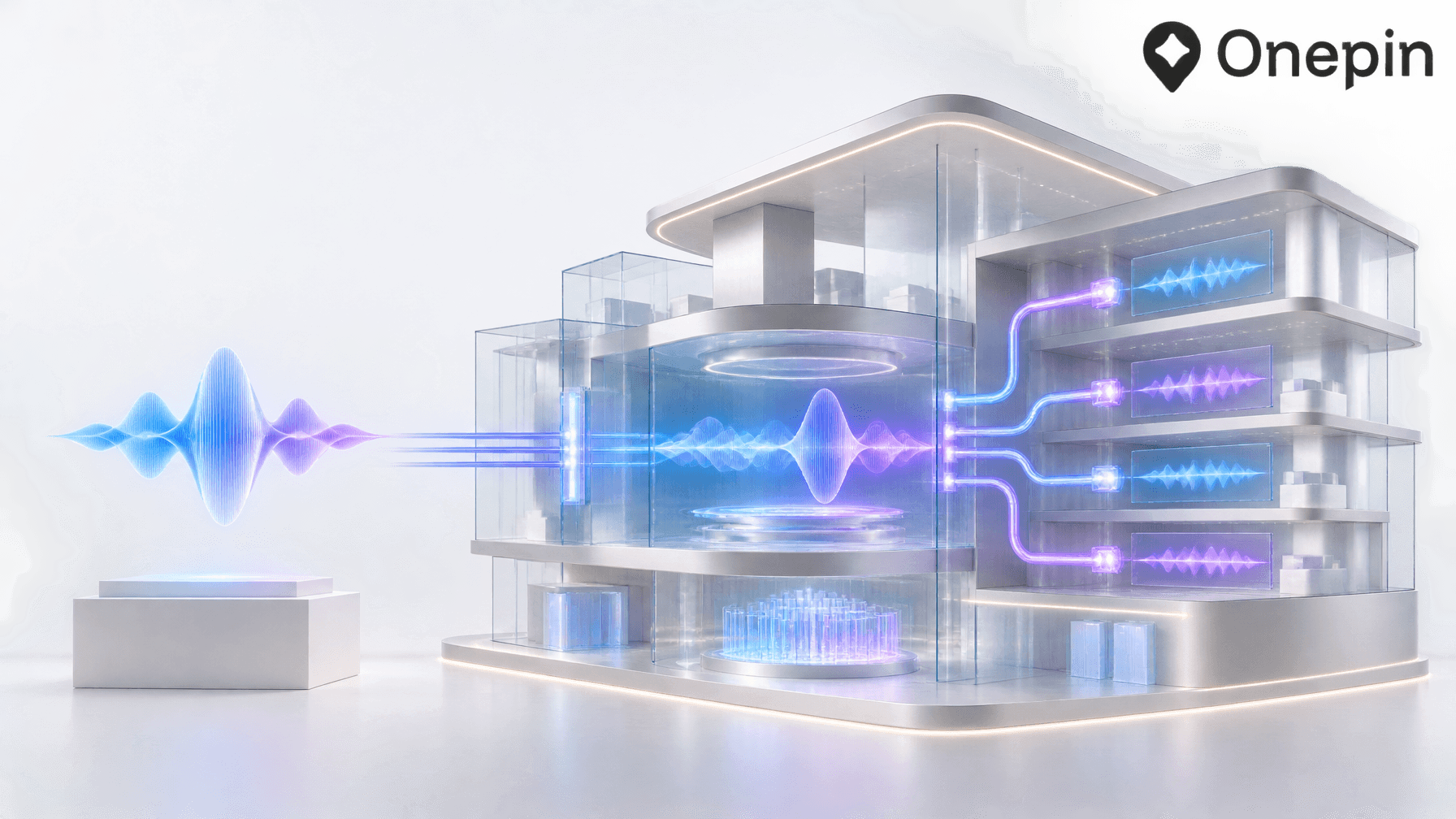
TLDR: A voice AI model converts text tokens into an audio waveform. A voice AI platform validates, routes, normalizes, and governs that audio across enterprise production workflows. Deploying a raw model endpoint directly into production forces your application layer to absorb rate limits, pronunciation drift, loudness swings, and format mismatches. A platform layer decouples your application from individual model failure modes.
A voice AI model is an acoustic neural network that converts text tokens into audio waveforms. A voice AI platform is an orchestration and validation layer that guarantees quality, format compliance, and reliability across enterprise workflows before audio reaches an end listener. Confusing an acoustic model with an operational platform is why so many voice AI initiatives produce impressive five-minute demos but stall during full-scale customer rollout.
According to engineering retrospectives compiled across enterprise deployments by MLQ.ai, enterprise generative AI implementations suffer failure rates exceeding 80% to 95% when architectural layers between raw model endpoints and production consumers are omitted. In real-time voice agents, speech benchmarks published by Soniox show that word error rate (WER) and time-to-first-sound latency (TTFS) vary dramatically across background noise profiles and conversational turns. When an acoustic model hallucinates, drops phonemes, or stumbles on specialized terminology, a raw model API returns flawed audio without warning. A platform detects the defect, executes automated remediation, and ships validated speech.
Understanding where the model stops and where the platform begins is the fundamental architectural decision in modern voice engineering.
What is the difference between an acoustic voice model and a voice platform?
An acoustic voice model is a single neural network architecture designed to solve acoustic token generation, whereas a voice platform is a multi-tier software system that manages the entire lifecycle of synthetic speech production.
| Architectural Dimension | Standalone Voice AI Model | Enterprise Voice AI Platform |
|---|---|---|
| Core Function | Generates raw audio waveforms from text tokens | Orchestrates, validates, normalizes, and routes audio |
| Failure Handling | Fails closed or outputs hallucinations directly | Automated retry, secondary provider failover, and fallback |
| Quality Assurance | None; assumes generated waveform is accurate | Automated ASR verification, pronunciation QA, and acoustic checks |
| Audio Formatting | Fixed vendor defaults (often 24 kHz MP3 or raw PCM) | Strict format negotiation, sample-rate conversion, and LUFS gating |
| Vendor Independence | Hardcoded client SDK and proprietary API schema | Unified abstraction layer supporting 100+ TTS models |
| Governance & Security | Per-vendor API key management and raw payload logging | Role-based access, audit logging, and PII redaction |
When developers integrate models from providers like ElevenLabs or Deepgram, they interact with raw inference endpoints. Each vendor exposes unique parameter definitions, rate limit ceilings, and audio delivery encodings. When an endpoint experiences network throttling or downstream latency spikes, a raw model integration pushes latency directly into user sessions.
In contrast, a voice AI platform wraps multiple model engines in a durable execution pipeline. The platform normalizes ingress text, checks phonetic lexicons, selects the optimal engine for the given language and domain, and inspects the audio buffer prior to transmission.
Why do standalone voice AI models fail in enterprise production?
Standalone voice AI models fail in production because they lack contextual verification, deterministic phonetic guardrails, and automated exception routing.
In academic benchmarks and controlled web playgrounds, speech synthesis models demonstrate remarkable naturalness and emotional prosody. However, production environments subject models to erratic inputs: alphanumeric part numbers, non-standard medical terms, code-switched multi-lingual dialogue, and fluctuating network packets. Benchmarks from Pipecat illustrate that streaming voice pipelines must maintain strict packet timing to prevent conversational breakdown.
Three architectural vulnerabilities routinely break standalone model integrations:
- Phonetic Drift and Acronym Hallucination: Neural vocoders predict acoustics based on statistical token probabilities. A raw model may pronounce "SaaS" correctly in one turn and spell out "S-A-A-S" in the next. Without an active lexicon and post-generation phoneme check, brand names, financial tickers, and medication dosages degrade silently.
- Format and Loudness Inconsistencies: One provider outputs 24 kHz MP3 audio with integrated loudness at -14 LUFS, while an alternative telephony model outputs 8 kHz linear PCM at -23 LUFS. Feeding mixed audio streams into downstream interactive voice response (IVR) systems causes jarring volume spikes and carrier protocol rejections.
- Availability Bottlenecks and Rate Limits: Cloud GPU inference clusters encounter regional capacity exhaustion. A direct API integration has no inherent mechanism to hot-swap to an equivalent voice timbre across an alternative provider without failing the customer call.
How does automated pronunciation and audio validation work?
Automated pronunciation and audio validation is an inline verification loop that analyzes generated synthetic speech against semantic, phonetic, and acoustic standards before audio dispatch.
In an unvalidated pipeline, text enters the model, and the resulting audio buffer streams directly to the media bridge. In a validated platform pipeline, the audio buffer enters a real-time inspection gate:
[Input Text / SSML]
         │
         ▼
[Text Normalization & Lexicon Injection]
         │
         ▼
[Optimal TTS Engine Selection]
         │
         ▼
[Acoustic Waveform Generation]
         │
         ▼
[Automated Validation Gate] ──► (Fails WER / Pronunciation Check) ──► [Instant Engine Failover]
         │
         ▼ (Passes Quality Gate)
[Loudness & Codec Normalization]
         │
         ▼
[Production Delivery to App / Telephony / CDN]
The validation layer runs an automated automatic speech recognition (ASR) pass or phoneme alignment over the generated waveform. If the system detects a pronunciation mismatch on protected terms, or if the audio contains acoustic clipping or unnatural silence artifacts, the platform discards the buffer. It immediately re-synthesizes the segment using an alternate voice profile or fallback provider.
This process occurs within milliseconds, preventing flawed audio from ever reaching customer ears.
How do voice AI platforms eliminate single-vendor lock-in?
Voice AI platforms eliminate vendor lock-in by decoupling application business logic from underlying acoustic inference APIs through unified abstraction interfaces.
The generative voice landscape is fragmented and evolving rapidly. A model leading English conversational prosody today may lack competitive European Portuguese or Japanese voice variants tomorrow. Committing an entire codebase to a proprietary vendor SDK forces engineering teams into costly, multi-month migration cycles whenever pricing models shift or higher-performing models emerge.
A voice AI platform establishes a standardized input-output contract. Your application sends text, desired voice attributes, and delivery requirements. The platform manages engine translation, parameter mapping, and output audio packaging behind the scenes.
Onepin is a voice workflow platform that orchestrates, validates, and ships production-ready audio across 100+ TTS models. By decoupling speech orchestration from single-engine dependencies, engineering teams maintain continuous uptime, enforce strict brand pronunciation guidelines, and dynamically route requests to the best-performing voice engine for every locale and budget tier.
To learn more about implementing production voice infrastructure, explore the Onepin Documentation. For deeper technical analyses, review our architectural teardowns on streaming TTS latency (TTFB vs TTFA), TTS audio format contracts, and what TTS orchestration is.
Frequently asked questions
- What is the difference between a voice AI model and a voice AI platform?
- A voice AI model is an acoustic neural network that converts text tokens into raw audio waveforms. A voice AI platform is an orchestration and operational layer that manages automated validation, dynamic routing, pronunciation lexicons, loudness compliance, and telephony integration above underlying models.
- Why do standalone voice AI models fail in enterprise production?
- Standalone voice AI models lack automated output verification, pronunciation governance, and fallback mechanisms. When an API encounters rate limits, hallucinations, or phonetic drift on acronyms, a raw model outputs flawed audio directly to end users without catching the defect.
- What is automated pronunciation validation in voice AI?
- Automated pronunciation validation is an automated quality assurance process that transcribes generated synthetic speech back into text or phonetic representations to verify word-level pronunciation before audio delivery. It prevents brand name corruptions, dropped digits, and hallucinated syllables.
- Can enterprises use multiple TTS models in a single voice AI platform?
- Yes. An enterprise voice AI platform abstracts vendor-specific API schemas, allowing teams to route traffic across multiple providers based on cost, latency requirements, language coverage, and voice timbre without rewriting application code.