Spotify's Audiobook Push Reveals AI Voice's Biggest Production Blind Spot
Spotify just moved its audiobook ambitions into the AI voice era. At its Investor Day event last week, the company announced a new ElevenLabs-powered tool inside its Spotify for Authors platform that lets self-publishing writers generate complete audiobooks from their manuscripts. The feature launches in beta this June, English-only to start, with ten additional languages to follow. Spotify already reports over a million Audiobook+ subscriptions and is on track to hit $100 million in annualized recurring revenue in the category.
The scale here is not hypothetical. Spotify has built a catalog of 700,000 audiobook titles, grown listening hours 60% year-on-year, and now wants every author with a word processor to have access to studio-quality narration. That is a genuinely large surface area for AI voice production.
What the announcement did not contain is a single sentence about what happens when the model gets something wrong.
What a TTS Model Actually Has to Handle at Audiobook Scale
Audiobooks are one of the most demanding production formats for text-to-speech. A full novel runs 80,000 to 120,000 words. It contains proper nouns the model has never seen: invented character names, foreign place names, technical terminology, brand names, and made-up words that appear nowhere in any training set. It demands consistent vocal tone and pacing across hours of continuous audio. And it carries a quality bar that listeners enforce: they notice when a character's name sounds different in chapter two than it did in chapter one, and they notice when a sentence clips mid-word.
None of that is a voice quality problem. ElevenLabs produces some of the most expressive, natural-sounding AI voices in the market today. That is genuinely impressive engineering. The problem is what happens after the model generates the audio. Who checks the output? Who catches the mispronounced character name that appears forty times across the novel? Who reruns the segment that clipped? Who flags the chapter where the model dropped a sentence entirely?
At Spotify's target scale, none of those questions have optional answers.
The Industry Keeps Confusing Voice Quality with Production Reliability
The AI voice industry has spent three years competing almost entirely on voice quality. Model after model arrives claiming to be the most natural-sounding, the lowest-latency, the most emotionally expressive. That competition has produced real results: today's TTS models sound dramatically better than anything available in 2023.
But the competition has created a consistent blind spot. Quality at the demo level is not the same as reliability at the production level. A model can generate a stunning 30-second sample clip and still produce a 6-hour audiobook with 40 mispronunciations, two dropped sentences, and one segment where the audio cuts without warning mid-word.
Production teams building voice workflows face the same set of problems regardless of which model they choose:
- TTS models fail silently. They produce audio that sounds plausible to a casual listener but contains errors a publisher or author would immediately catch.
- No single model handles every input type equally well. Technical jargon, proper nouns, and foreign-language words expose different weaknesses across different providers.
- Long-form generation compounds error rates. A 1% failure rate across a single chapter means multiple problem segments per file.
- Retry logic defaults to manual. A bad segment requires a human to notice it, flag it, re-submit it, and verify the new output.
The industry has treated these as edge cases. They are not. They are the standard production environment the moment you move from a demo into a real content pipeline.
Spotify's announcement is a clear example of how this plays out at the platform level. The company is routing author manuscripts through a single TTS provider with no public discussion of output validation, pronunciation correction, segment-level quality checks, or failure handling. The implicit bet is that the model quality is high enough that these concerns do not apply at scale. That bet gets harder to sustain as the catalog grows from 700,000 titles toward whatever Spotify's actual ceiling is.
What Production-Grade Audio Actually Looks Like
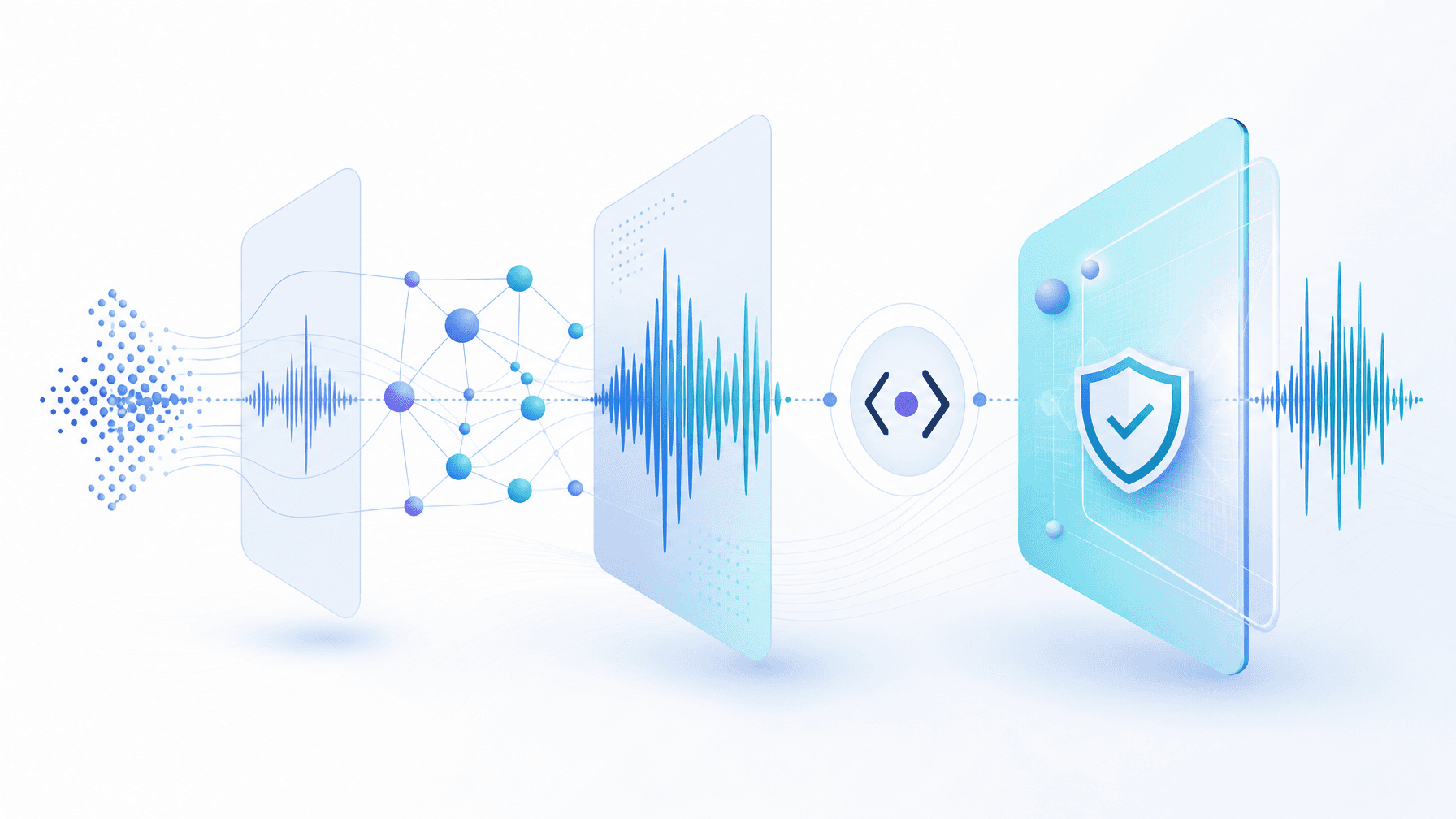
Shipping reliable audio at scale requires a layer that operates above any individual TTS model. That layer plans the job, monitors each output segment, validates pronunciation and completeness, catches failures before the file ships, and retries automatically using a different model when the first attempt misses the mark.
This is exactly what Onepin does. Rather than replacing ElevenLabs or any other TTS provider, Onepin operates as an orchestration and validation layer on top of 100+ TTS models. When a production team routes a manuscript through Onepin, the system breaks the job into segments, validates each output against quality benchmarks, retries failed segments across alternative models, and delivers the completed audio only when it clears those checks.
Authors and publishers do not see the retries or the validation passes. They receive a clean, consistent file. That is what production-grade audio looks like in practice.
The question Spotify's announcement raises, without answering, is what happens to author trust when AI-generated audiobooks start arriving with errors at scale. A mispronounced protagonist name repeated through 20 chapters is not an edge case. It is a predictable output of running long-form generation through a single model with no downstream validation. As Spotify scales this feature to hundreds of thousands of authors, the failure rate becomes a product decision, not a model limitation.
A TTS model is a tool. A production pipeline is what turns that tool into a product authors and listeners can rely on.
If you build audio at scale and want to understand what production-grade voice orchestration looks like, start at onepin.ai.
Frequently asked questions
- What did Spotify announce for AI audiobooks?
- At its Investor Day event, Spotify announced an ElevenLabs-powered tool inside its Spotify for Authors platform that lets self-publishing writers generate complete audiobooks from their manuscripts. The feature launches in beta in June, English-only to start, with ten additional languages to follow.
- Why are audiobooks a demanding format for TTS?
- A full novel runs 80,000 to 120,000 words and contains proper nouns the model has never seen, including invented character names, foreign place names, and made-up words. It demands consistent vocal tone and pacing across hours of audio, and listeners notice when a character's name sounds different between chapters or when a sentence clips mid-word.
- What production problems does the Spotify announcement overlook?
- The announcement said nothing about what happens when the model gets something wrong. Spotify is routing author manuscripts through a single TTS provider with no public discussion of output validation, pronunciation correction, segment-level quality checks, or failure handling.
- Why is voice quality not the same as production reliability?
- A model can generate a stunning 30-second sample and still produce a 6-hour audiobook with 40 mispronunciations, two dropped sentences, and one segment that cuts mid-word. TTS models fail silently, no single model handles every input type equally well, and long-form generation compounds error rates.
- How does Onepin ship reliable long-form audio?
- Onepin operates as an orchestration and validation layer on top of 100+ TTS models. It breaks the job into segments, validates each output against quality benchmarks, retries failed segments across alternative models, and delivers the completed audio only when it clears those checks.