TTS Quality Assurance: How to Catch AI Voice Errors Without Re-Listening to Every Clip
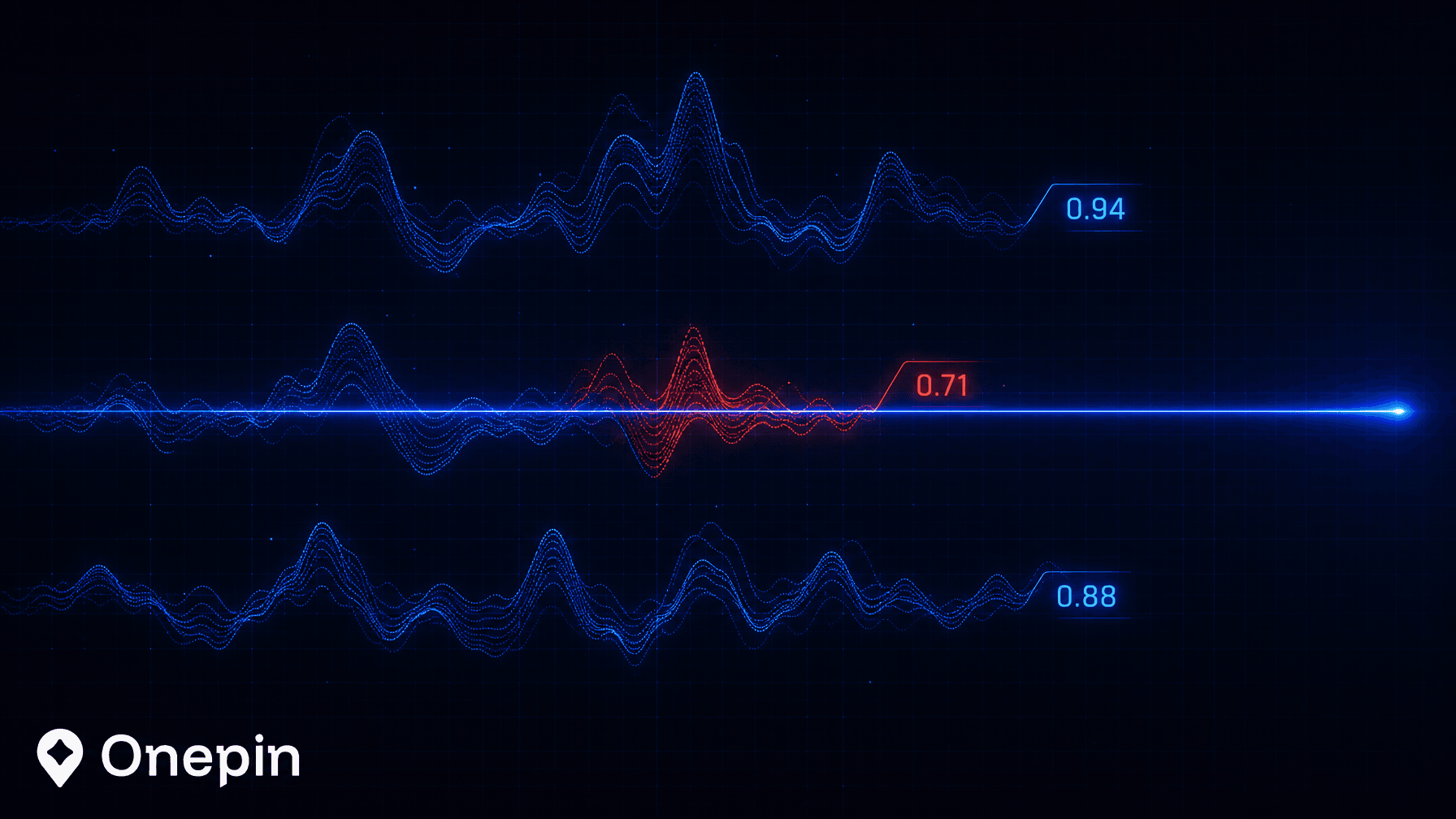
TTS quality assurance is the practice of scoring every generated audio clip against defined quality standards before it ships, using automated metrics rather than manual listening. The core challenge in production is not generation. TTS models do that reliably. The challenge is knowing which clips pass and which clips fail without a human ear on every file. Teams without automated TTS evaluation ship errors silently, at scale.
What is automated TTS evaluation?
Automated TTS evaluation runs each generated clip through a scoring pipeline that measures quality across multiple dimensions simultaneously. A manual listener can review maybe 10% of a large batch on a good day. An automated evaluator scores 100% of output in the same time it takes to generate. The components of that pipeline determine what kinds of errors you actually catch.
The four dimensions automated TTS evaluation covers:
Pronunciation accuracy. The pipeline checks whether words in a known vocabulary set (brand names, product terms, proper nouns) are pronounced correctly. This uses phoneme-level alignment tools that compare the acoustic signal against expected phoneme sequences. No general-purpose neural scoring model tells you whether a specific brand name was mispronounced. That requires a reference pronunciation stored for that exact term.
Acoustic consistency (MOS and UTMOS scoring). Neural Mean Opinion Score predictors like UTMOS assign a numeric quality score to each clip without a human listener. They measure naturalness, fluency, and artifact presence. A score of 4.0 is acceptable; a score of 3.2 warrants review. Running UTMOS on every clip turns "sounds fine" into a number you can threshold and alert on.
Format compliance. TTS output often mismatches delivery requirements: sample rate wrong for telephony (8kHz G.711 vs 24kHz PCM), loudness outside LUFS targets, silence padding absent, codec incompatible with playback hardware. Format errors fail silently: the file exists and plays, but downstream systems break. Automated format validation catches these before they reach the delivery layer.
Model version integrity. TTS providers update their models without notice. An output generated today from the same prompt may differ acoustically from one generated last month. Version tracking in the pipeline catches this before it becomes a regression.
Why does "sounds fine on 10 clips" fail at 10,000 clips?
The tail problem is simple arithmetic. A 2% failure rate (mispronounced brand name, acoustic artifact, clipped silence) produces 200 bad clips in a batch of 10,000. Those 200 clips distribute randomly through the output set. Manual spot-checking 50 clips catches roughly 1 of them statistically. The other 199 ship.
The failure rate is not constant across a vocabulary. Edge cases accumulate in the tail of a large or specialized word list. A TTS model that pronounces a product name correctly 98% of the time will mispronounce it on specific surrounding phoneme contexts, specific punctuation patterns, or specific voice settings. You cannot predict which inputs produce which failures. You can only measure outputs.
This is what production teams on developer forums describe as the "evals for audio" gap. Code evals run automatically on every pull request. Audio evals run on a sample on a good day, and not at all when the team is under deadline pressure. That gap is where bad clips reach end users.
A production vocabulary of 500 product names, 200 named entities, and variable number formats has thousands of pronunciation surfaces. Listening to a 10-clip sample before launch does not cover that surface area. A scoring pipeline running on every generated clip does.
How do you build a TTS quality baseline?
A quality baseline starts with 20 to 50 golden clips. Generate them under controlled conditions: a locked model version, fixed voice parameters, and input text that covers your production vocabulary, including the proper nouns, brand names, and number formats most likely to trigger mispronunciation.
Store each clip alongside its metadata: model version, voice ID, generation timestamp, UTMOS score, and pronunciation verification status for every term in your vocabulary set. These golden clips become the reference for all future batches.
When you generate a new batch, the evaluation pipeline runs three comparisons against the baseline:
- UTMOS delta. Mean quality score of the new batch versus the baseline. A drop of more than 0.3 points warrants investigation.
- Pronunciation accuracy delta. Alignment scores on your vocabulary set compared to baseline. Any term that passes baseline validation and fails in the new batch is a regression.
- Acoustic signature comparison. Spectral characteristics (pitch distribution, energy envelope, formant structure) compared to baseline via cosine similarity. This catches voice drift that UTMOS alone misses.
The result is a per-clip quality score and a batch-level summary that tells you whether the new output matches expectations before a single file ships.
What does model version drift actually break?
Silent model updates are the most common source of unexplained quality regressions in production TTS pipelines. A provider pushes an update to improve naturalness on conversational text. The update also changes phoneme handling for technical vocabulary in ways the provider did not test. Your pipeline generates the same prompts as last week. The output sounds similar. The UTMOS score is marginally higher. But 12 product names that passed pronunciation validation last week now fail.
Without a baseline, you find this regression when a user reports it. With a baseline, you find it in the first post-update batch, the same day the provider pushed the change.
Version locking addresses part of this problem. But version locking only works if you know which version you are locked to and you have a baseline that reflects that version. A version lock without a stored baseline is a reference with no reference point.
What should an "evals for audio" system actually do?
The complete system includes these components:
Per-output scoring. Every clip gets a UTMOS score, a pronunciation verification result for each term in the vocabulary set, a format compliance check, and a pass or fail decision. This runs automatically on generation, not on request.
Baseline comparison. Every batch gets compared against the stored golden set. Deltas above threshold trigger alerts before the batch proceeds to delivery.
Version tracking. The model version used for each generation is recorded. When the provider updates, the system detects the acoustic shift and flags it for baseline re-validation before production use resumes.
Automated retry. Clips that fail scoring get regenerated automatically, up to a configurable retry limit. Clips that fail after retries get escalated for human review: only those clips, not the entire batch.
Audit trail. Every clip ships with its quality score, model version, and generation metadata attached. Downstream teams can verify what produced each output.
This is what TTS orchestration means at the output layer. The best TTS models generate audio reliably. The evaluation layer decides which audio ships.
Onepin is a voice workflow platform that orchestrates, validates, and ships production-ready audio across 100+ TTS models. Per-output quality scoring, automated baseline comparison, version locking, and retry logic are built into every pipeline. If your team currently listens to clips to decide what ships, that is the gap Onepin closes. Learn more at onepin.ai.